Showing posts with label 1809. Show all posts

May 7, 2013

Santo Domingo, 1809

Discovered c.1796 and reported in 1810 (lowering French prices?), the Santo Domingo platina was very poor, 46% Pt.

c.1810 : 1 Troy Ounce platina = $S 0.20


If "a few Maravedis" = M 10 (S$ 0.01984) per castellano:

c.1810 : 1 Troy Ounce "platina" (Yaqui ore, 40% unwashed sand) = S$ 0.134
c.1810 : 1 Troy Oz. platina (Yaqui platina, 46% Pt) = S$ 0.2237
c.1810 : 1 Troy Oz. Pt (Yaqui platina, intrinsic) = S$ 0.486

If "a few Maravedis" = M 15 (S$ 0.03) per Onza:

c.1810 : 1 Troy Ounce "platina" (Yaqui ore, 40% unwashed sand) = S$ 0.03
c.1810 : 1 Troy Oz. platina (Yaqui platina, 46% Pt) = S$ 0.054
c.1810 : 1 Troy Oz. Pt (Yaqui platina, intrinsic) = S$ 0.116


December 12, 2011

Germany, 1809

At a period when Napoleon's army invaded Germany, the currency price of precious metals varied - at a premium, in times of war.   Nor is it clear when refined Platinum was sold cheaply, as some contemporary French writers warned the purported article was in fact SILVER.   After Jeannetty (1800-1813), the Platinum trade of particular mention by German contemporaries  include both Wollaston's  agent in London, Wm. Carey (1805) and Bréant in Paris (1813-19.)  Presumably, both offered competitive rates.

For lack of reference, it may be presumed there were no significant German producers until 1828.  Prior to that date, manufactured Platinum sold in Germany or Austria was imported.

1800: 1 Troy Ounce Platinum = Wien. Fl. 16. (Fr. 42.31)
1809: 1 Troy Oz. Platinum (bulk, producer) = Fr 27.43 (USD$ 6.43)
1809: 1 Troy Oz. Platinum (pure, producer) = Fr 36.57 (USD$ 8.58)
1809: 1 Troy Oz. Platinum (scrap, Buyer's Price) = Fr 15.24 (USD$ 3.57)

"Der preis der platina ist bisher noch nicht fixirt gewesen, weil man von diesem herrlichen metalle noch zu wenig gebrauch machte; man hat es es daher bald theuer wie Gold, bald wohlfeil verkauft."

"the price of platina has not yet been fixed, because too little use was made of this magnificent metal; so then it's erratically dear as gold, soon to be sold cheaply." 

Citation: Oekonomische Encyclopaedie oder allgemeines System der Staats- Stadt- Haus ... ;  Johann Georg Kruenitz, Floerke (1810) p. 391


Where the Gold Price was (19.16 = @ 202.758 Rthlr.)


1809: 1 Troy Ounce Gold = 10.582 Rthlr.

Where the Gold Price was (29 Marks x 19.16 = 555.64 Troy Ounces @ 5,880 Rthlr. Preus. Cour.)  

1809: 1 Troy Ounce Gold = 10.582 Rthlr Cour.

Where the Gold Price was (19.16 @ 236.6 C.M.)  

1809: 1 Troy Ounce Gold, coined = 12.348 Fl. C.M.


October 16, 2011

Adam Smith's Inquiry into the Wealth of Nations (Editor's Note)

A Note (XLI) by Marquis Garnier in the Second French Edition (after 1802) correctly translates von Humboldt's 1801 Colombian price "Fr 40 per libra" (castellano) as Fr 80 per kilogramme. The kilogramme was based on the poid of 2 marc (the marc divided into 8 ounces); the Castellano was analoguous to the marc.

By direct implication and logic, von Humboldt's cited Paris platina price was for the approximate 500 gram 'poids de marc' and not per kilogram. Otherwise, the estimation would nonsensically, double the weight, or halve the price of all precious metals.
Footnotes in the Second Edition manuscript date to 1821, when von Humboldt was still resident in Paris.  From 1815-20, the Paris price for the best platina (Fr 4.06 -5.08) was  approximately and consistently ~4x more expensive than the Colombian source ; cheap grades of ore were likely sold at lower rates.  It's interesting to note that Paris platina had often been only ~3x more expensive than the source earlier on (1800 - 1810) but rising global demand for Platinum intensified European speculation in the raw commodity around 1820 (more explicitly than Garnier revealed.)

Vulgar speculation in refined Platinum, in Paris & London, likely appeared two years later, in 1822/3, as rumors of the Colombian government's interest in coinage circulated.

c.1821
The amount of platinum that comes annually to the European market is perhaps not a thousandth of the amount of money coming into the same market, yet a mark of platinum is not worth the two cinqu1èmes of a mark of money. According to Humboldt, platinum is worth only 80 francs per kilogram instead of the extraction, although the trade sell-often three to four times more expensive, because in an article also scarce, dealers are almost always the key to the law to those who seek to fill it.

Citation: Recherches sur la nature et les causes de la richesse des nations; Adam Smith Vol. 5 (1822) p.663


From von Humboldt's original (ms. of 1809):

September 10, 2011

France, 1809

Jeannetty mentions the various clients and industries using his Platinum (similar to Wollaston's, but with dentists before chemists) and names several agents in Lyon.  

The Paris manufacturer's Lyon offer would necessarily include all transportation costs and depot markup, at a price significantly higher than Platinum in Paris. The price differential between Jeannety's Scrap Bid in Lyon (Fr. 15) and to chemists (Gehlen: Fr. 13) may reveal the minimum regional markup, typically known as "franc de port," or Fr. 2/Once, ~ 15.4% over the Paris retail price; the Lyon agent's trade discount would be additional, for a total markup conservatively estimated to be ~20%. 


1809: 1 Troy Ozt. Platinum (Paris: Scrap, Bid) = Fr 13.22 ($ 2.48)
1809: 1 Troy Ozt. Platinum (Paris: Semi-Mfg, Whols.) ~ Fr 22.36 ($ 4.19)
1809: 1 Troy Ozt. Platinum (Paris: Mfg, Whols.) ~ Fr 30.50 ($ 5.72)
 
1809: 1 Troy Ozt. Platinum (Paris: Scrap, Bid) = Fr 13.22 ($ 2.48)
1809: 1 Troy Ozt. Platinum (Paris: Semi-Mfg, Trade) = Fr 25.41 ($ 4.77)
1809: 1 Troy Ozt. Platinum (Paris: Mfg, Retail) = Fr 34.56 ($ 6.48)
 
1809: 1 Troy Ounce Platinum (Lyon: Scrap, Bid) = Fr 15.25 ($ 2.86)
1809: 1 Troy Ozt. Platinum (Lyon: Semi-Mfg, Trade) = Fr 27.45 ($ 5.15)
1809: 1 Troy Ozt. Platinum (Lyon: Mfg, Retail) = Fr 36.60 ($ 6.86)
 
... made this precious metal suitable for use in firearms, whether for breech-bush or for reinforcing pan-screws, and preferably replaces gold for these different uses; it is more substantial and less vulnerable to all reagents.  Messrs. Boutet, of the arms factory at Versailles, Lepage, Arlaut and all the musketeers in Paris are well served {by Platinum}, as well as dentists and chemists.  The price is Fr. 27  per Once, and Fr. 36 for chemists, entirely ready, and I take back scraps, filings and pieces deriving therefrom, free of all foreign matter, for Fr. 15 per Once.  Refer me to the width of breech-bush and size of the pan-screws that you desire; I will deliver them with the greatest accuracy the depot that is at M. Laurent-Micallef, Goldsmith, Place de l'Herberie No.111, in Lyon. I have a depot for musketeers at Messrs. Buisson, Goldsmiths, Rue Froide, Saint-Etienne.

Janety, Member of the Société des inventions et découvertes, Rue du Colombier in Paris.

Citation: Bulletin de Lyon Ballanche père et fils ( No. 55 : 7/12/1809) p.217


Retail jeweler (marchand orfèvre) Jean-Baptiste Laurent-Micalef (1798-c.1814) at Place de l'Herberie, n. 111, Lyon.


(Petrus?) Buisson, Rue Froide, St-Etienne (major gun manufactory.) 


1809: Franc de port = Fr. 2.


Jean Le Page (1746-1834) luxury arms manufacturer; Arlaut: gun manufacturers.


Where 1 Livre, poid du Marc = 1.31268 English Troy Pounds @ Fr 130., 1 English Troy Pound of platina would cost Fr 99.03 or  

1809: 1 Troy Oz. platina (bulk?) = Fr 8.253 (S$ 1.6506)
1809: 1 Troy Oz. platina (intrinsic, 75% ore) = Fr 11. (S$ 2.20)
1809: 1 Troy Oz. Pt (labor) = Fr 4.24 (S$ 0.8472)


1809: 1 Troy Oz. Platinum (scrap, Buyer's Price) = Fr 15.24 (USD$ 2.88)
1809: 1 Troy Oz. platina (retail) = Fr 27.43 (USD$ 5.18)

1809: 1 Troy Oz. Platinum (pure, producer) = Fr 36.57 (USD$ 6.90)
1809: 1 Troy Oz. Pt (Producer's Recycling Cost) = Fr 19.48 (USD$ 3.68)
1809: 1 Troy Oz. Pt (Producer's Profit, Sponge) = Fr 17.09 (USD$ 3.22)

1809: 1 Troy Oz. Platinum (Producer's Sheet) = Fr 39.17 (USD$ 7.39)
1809: 1 Troy Oz. Platinum (Producer's Mfg) = Fr 48.61 (USD$ 9.17)
   
Curious phrasing of von Humboldt suggests a recent Paris price change.  The 'common price' would be wholesale, but he doesn't indicate a "current price."

Gehlen (1809?) complained of Janetty's manufactured price, and Paris scrap price (in trade) was nearly as high as retail ore.  The apparent price of ore was nearly twice as expensive, perhaps because of the English trade embargo and disrupted Atlantic trade.

All this suggests price volatility and/or platina supply issues on the Paris market (which explains a persistently high retail price.)  

See more on Commodity Prices of 1809.


c.1808/9:


c.1808?
Citation: Political essay on the kingdom of New Spain; Alexander von Humboldt (1811) p.383


February 28, 1810: reference to Winter 1809/10: the price of Platinum was falling, but remained ~1: 3 or 1:4 yet. 

Platinum Vase, 18 Ozt: 18.9 cm diam, 13.5 cm deep. (7.44 in. by 5.315 in.)
Platinum Retort, 27.65 Ozt: 1 Litre
 
Citation: Bulletin, Vol. 5; Société d'encouragement pour l'industrie nationale, p. 56


Reported 10 February 1810, for the Year 1809:

Citation: Archives des découvertes et des inventions nouvelles, Vol. 3 (1810)


Platina which comes to be found in Spain and Santo Domingo becoming less rare every day in trade must necessarily diminish value, and can, after this, thinking forward some years, its price will be that of Gold in the ratio of lower than 1-to-4.


Curious reference in 1835 German textbook: Platinum was first worked systematically in France in 1808.

Citation: Geologie: oder Naturgeschichte der Erde, Vol. 1 Karl Cäsar von Leonhard (1836)


c. 1809: If ~70% of Wollaston's refining business was for 'touch-hole quality' Platinum, Continental production for gun-manufacturers was probably equally important at this time.  The retail mark-up may also reveal the retail price of Platinum.

April 25, 2011

UK, 1809: Platinum Stills

It appears that several Platinum stills were "first manufactured" in this year, but the earliest was 1805.  Close examination of the December 1809 price record suggested the construction of the Platinum boiler (net Cu and Au) weighed 431.25 ozt, cost £ 288.512 (17.89 s. per Ozt.)

Second Platinum Still, for Thomas Farmer, by Dr. Wollaston is clearly not 423 Ozt (unless the Copper-weight was 90 Ozt?)

In addition to 300.75 Ozt Platinum, Wollaston's Still for Farmer (#2) contained Gold and Copper as well : £ 300. net £ 13.875 = £ 286.25 or 

1809: 1 Troy Oz. Platinum (Mfg, Still)  = £ 0.8651 (S$ )

Labor was underestimated, however, and fair value was presumed somewhat higher (1810.).
 

1809: 1 Troy Oz. Platinum (Mfg, Still)  = £ 0.9119 (S$ )
  
Fully manufactured Platinum cost +49% more than retail sponge, +258% over Scrap Bid.  Refined Platinum was +140% the Scrap Bid. Wollaston's purported Platinum price for this still is low compared to a Johnson Still manufactured in the same year.

1809: 1 Troy Oz. Platinum (Scrap bought)  = £ 0.25 (S$ )
1809: 1 Troy Oz. Platinum (Refined, Sponge?)  = £ 0.60 (S$ )
1809: 1 Troy Oz. Platinum (Mkt)  = £ 0.80 (S$ )
1809: 1 Troy Oz. Pt Labor (refined,worked sheet)  = £ 0.0130 (S$ ) 
1809: 1 Troy Oz. Pt Labor (Mfg, still)  = £ 0.0817 (S$ ) 
1809: 1 Troy Oz. Platinum (Mfg, Wollaston Still)  = £ 0.8946 (S$ )

1809: 1 Troy Oz. Platinum (Mfg, Wollaston Still)  = £ 0.93 (S$ 5.174)


c. 1833: This reference is presumably to the 1830s, when Platinum stills cost ~£ 1.22 - 1.25
 

Wollaston's platinum still for Richard Farmer entailed various manufacturing fees of 2s. 7.25d per Ozt. in a ~300 Ozt. still.

1810: 1 Troy Oz. Platinum (Refined)  = £ 0.80 
1810: 1 Troy Oz. Platinum (Mfg)  = £ 0.9302


Sulfuric acid c.1795 was £ 0.033/Lb. avd.; in 1840, ~£ 0.004


c.1809:
1809: S$ 1.0 = £ 0.225 ; S$ 4.44 = £ 1.0


1809:
  
  
Period of Depreciation:


May 20, 2010

UK, 1812-32: Falling Prices of Commodities, Manufactures; Platinum a Deflation Hedge

From 1805 - 1832, The UK experienced severe deflation: a -36% fall in a broad English commodity index (Seligman's 1913 chart, on Jevon's & Sauerbeck's averages) is evident.  From 1816 - 1832,  the same index fell -12%.

However, from 1815 - 1830 the UK price of refined Platinum rose ~ 25%:  £ 1.0 > 1.25.

1805: 1 Troy Ounce Platinum (refined, retail)  = £ 0.75 (USD$ 3.26)
1815/6: 1 Troy Ounce Platinum (refined, retail)  = £ 1.05 (USD$ 3.26)
1830: 1 Troy Ounce Platinum (malleable) = £ 1.25 (USD$ 6.08)
 
From 1815 - 1832, the price of British Platinum stills (used for concentrating sulphuric acid, then an expensive industrial chemical) increased +57%.
    

1809-15: 1 Troy Oz. Platinum (Wollaston mfg.) = £ 0.83 (USD$ 3.)
1832/3:  1 Troy Ounce Platinum (mfg, British alembic)  = £ 1.21 (USD$ 5.88)

Citation: The English cyclopædia: a new dictionary of universal knowledge, Volume 6, edited by Charles Knight (1858), p.797


Simultaneously, other English metal products witnessed 50 - 85% price declines.   Charles Babbage's price tables for simple British manufactures illustrate severe deflation for the same period.  This appears to have bottomed in 1830, coincident with The Swing Riots and perhaps the normal outcome of deflationary monetary policies and the Crash of 1825, a global financial event described by Bordo (1998.)  

Though the English platinum production was insignificant at this time, the price stability & growth in this small industry remains especially noteworthy.

Citation: On the economy of machinery and manufactures, By Charles Babbage, p.153


1800-18: Currency Depreciation (a Rising Gold Price) wrecked havoc on merchandise producers


 Export Price of UK Bar Iron
 

April 28, 2010

Colombia, 1805-09: Platina Export Price

DSQ


Visiting Chocó in 1801, Alexander vonHumboldt subsequently declared the spot-price for platina was 8 Piastres Reals per Spanish Pound (= 100 castellanos [1 castellano = 71 grains troy] = 7100 grains = 14.792 troy ounces.)  Whereas von Humboldt's specimen-price might have been the higher local rate for very best quality ore (and a poor trade), the market-price for bulk or wholesale platina was certainly much lower. 

Given a presumed exchange at Cartagena for Sterling (S$ 1. = £0.2082) and an 8% premium for 'Spanish Plate' in the former English Colonies (USA: 6 Piastres = [1.08*$6.], etc.) the trader's export rates for Colombian platina may be estimated

@ 8 Piastres
1 Troy Ounce platina (raw ore, in Colombia) = S$ 0.541
1 Troy Ounce platina (raw ore, in Colombia) = USD$ 0.584
1 Troy Ounce platina (raw ore, in Colombia) = £ 0.110
1 Troy Ounce platina (raw ore, in Colombia) = Fr 2.704

@ 7 Piastres
1 Troy Ounce platina (raw ore, in Colombia) = S$ 0.473
1 Troy Ounce platina (raw ore, in Colombia) = USD$ 0.51
1 Troy Ounce platina (raw ore, in Colombia) = £ 0.0967
1 Troy Ounce platina (raw ore, in Colombia) = Fr 2.37

@ 6 Piastres
1 Troy Ounce platina (raw ore, in Colombia) = S$ 0.406
1 Troy Ounce platina (raw ore, in Colombia) = USD$ 0.438 

1 Troy Ounce platina (raw ore, in Colombia) = £ 0.0829
1 Troy Ounce platina (raw ore, in Colombia) = Fr 2.03

@ 5 Piastres
1 Troy Ounce platina (raw ore, in Colombia) = S$ 0.338
1 Troy Ounce platina (raw ore, in Colombia) = USD$ 0.365 
1 Troy Ounce platina (raw ore, in Colombia) = £ 0.069
1 Troy Ounce platina (raw ore, in Colombia) = Fr 1.69

@ 4 Piastres
1 Troy Ounce platina (raw ore, in Colombia) = S$ 0.270
1 Troy Ounce platina (raw ore, in Colombia) = USD$ 0.292 

1 Troy Ounce platina (raw ore, in Colombia) = £ 0.055
1 Troy Ounce platina (raw ore, in Colombia) = Fr 1.352

@ 3 Piastres
1 Troy Ounce platina (raw ore, in Colombia) = S$ 0.203
1 Troy Ounce platina (raw ore, in Colombia) = USD$ 0.219 

1 Troy Ounce platina (raw ore, in Colombia) = £ 0.0414
1 Troy Ounce platina (raw ore, in Colombia) = Fr 1.01

1805: 1 Troy Ounce platina (Cartagena) ~ S$ 0.406 
1806: 1 Troy Ounce platina (Cartagena) ~ S$ 0.406  
1807: 1 Troy Ounce platina (Cartagena) ~ S$ 0.406 

1808: 1 Troy Ounce platina (Cartagena) ~ S$ 0.406 
1809: 1 Troy Ounce platina (Cartagena) ~ S$ 0.406  

Mollien's confusion must include the total volume of platina exported: 6,000 libras is 2,760 kgs, an impossibly high annual export.  At 6,000 castellanos (60 libras), the yearly recorded platina export was more likely 888 ozt. (27.6 kgs.)  Had the estimated value been 6 reales per castellano (S$ 0.75) or S$ 75. per libra, the European price would have been multiples higher - also impossible.

At English Retail, 1 Libra platina sold in the UK cost S$ 17.59 - 17.85; the European Commercial Price was ~3x greater than at export.

Reconciliation implying an official annual export of 60 libras @ S$ 6. per, ~S$ 360. with an unknown additional export (5x greater?) as contraband, perhaps ~ 165.6 kgs/ann. in a poor period of precious metals production?

Citation: Travels in the Republic of Colombia: in the years 1822 and 1823 By Gaspard Théodore Mollien (comte de) (1824) p.454


Where the specific gravity of Platinum was assumed 21.3, Wollaston's platina was between ~70.4% - 79.81% pure.

Citation: Encyclopaedia Londinensis, or, Universal dictionary of arts..., Vol. 15 p.479


From 1804 - 09, Carthagena was essentially a free-trade open-port.  In this time, Chocó slaves could profitably extract for masters but also illicitly gather and sell the metal, purchasing their own or loved ones' freedom.  By Mollien's erroneous estimation ('correction'?) above, the annual platina export from 1804-09 was 88,752 Troy Ounces (2,760.6 kilgrams).  Resprepo's (1809) estimate was 81,356 English Troy Ounces (2,530 kgs or 1,240.9 libras) or ~248 kgs annually.

In 1804, the Barca El Serrano carried 134.54 kgs to Cadiz and the British Navy intercepted another ~124.4 kgs.  This suggests a minimum official platina export to Europe ~719 kgs that year alone.

With increasing manumission during the Civil Wars and after trade restrictions were imposed, the platina yield likewise fell after 1818. According to Cochrane, visiting in 1823 when Colombian Platinum was in greatest demand, about ten quintales of platina (14,790 English Troy Ounces, or 460 kgs) were extracted annually from Chocó.  Dr. Jose Manuel Restrepo reported at the price peak (1826) : "the amount of platinum that is exported is small, which sound data indicates cannot exceed 1,500 libras ( = 22,188 Troy Ounces or 690.14 Kgs) per year.  Platinum is worth 16 to 20 pesos per libra."

Resrepo (1809) estimated Gold yield at 2,300 - 2,760 kgs per year; therefore, platina was 25-30% that amount or about one-fifth the total PM yield for the region.

In 1809 Dr. José Manuel Restrepo, published an essay on the geography of Antioquia in the weekly El Semanario de la Nueva Granada:  "[In 1808 ] this branch of industry, the only export, amounted annually 500 - 600,000 castellanos (1,250,000 pesos), according to the best estimates."

The Colombian source price was steadily declining, 1803-14. This corresponds to both the falling London Platina price (recorded by Wollaston) and the Paris Platinum Collapse in 1811/2.

In late 1801/ early 1802, the Spanish Crown attempted to reassert control over the illicit trade in platina contraband ; by May 1803, however, British merchants had free reign on the Spanish Main. It appears likewise from Wollaston's account books: the source price of platina was falling almost continuously for a decade.

Citation: A voyage to the eastern part of Terra Firma, or the Spanish Main ..., Vol. 2 François Joseph Pons (1806) p.320

Spanish merchants typically marked-up imported contraband goods for retail 25-35%; it's not clear commodities from the interior rose as much.


Mollien (1824) cites a Consulate official's estimation to the Viceroy of the average price-weight Choco platina "during the six years anterior to 1810" @ 6 Piastres per Spanish Pound at Carthagena.  (The French traveler's 1823 Choco platina spot-price is far too low, by a local German merchant's opinion.)

Citation: Bulletin of the Pan American Union, Vol. 45 (1917) p.622

The Colombia export price of platina was dropping fast. The price bottom was presumably reached in 1811/12, when Cuoq, Couturier & Cie. acquired a very large supply and caused the price of refined Platinum in Paris to drop by >50% in Paris, c.1815.

The Wuretmburg Centner corresponded to the Spanish quintal almost exactly, 103 lbs avoirdupois.


The very stable London retail prices seem indicative. Despite rising demand, Wollaston's suppliers' prices trended down for nearly 15 years. Sharply falling Paris retail prices in the same period are also evident. All these factors imply declining wholesale platina prices, despite any brief interruptions in trade (due to war):

1804 @ 7 $ 0.51 ; £ 0.10 ; Fr. 2.37
1805 @ 7 $ 0.51 ; £ 0.10 ; Fr. 2.37
1806 @ 5 $ 0.37 ; £ 0.07 ; Fr.1.69
1807 @ 6 $ 0.44 ; £ 0.060 ; Fr. 2.03
1808 @ 6 $ 0.44 ; £ 0.060 ; Fr. 2.03
1809 @ 5 $ 0.37 ; £ 0.07 ; Fr.1.69

In 1801, von Humboldt reported the Choco & Paris price for platina, 3x the Source Price.

8 Spanish Piastres ($) /14.792 troy ounces =


1801: 1 troy oz. platina (raw ore) @ Choco = Span $ 0.54
1801: 1 troy oz. platina (raw ore) @ Choco = Fr 2.70
1801: 1 troy oz. platina (raw ore) @ Paris ~ Fr 8.26

c.1804-1809: Mollien (1824) reported earlier platina prices

6 Spanish Piastres ($) /14.792 troy ounces =
1804: 1 troy oz. platina (raw ore) @ Choco = Span $ 0.41
1804: 1 troy oz. platina (raw ore) @ Paris ~ Fr 8.25
 
1804 @ 7 $ 0.51 ; £ 0.10 ; Fr. 2.37
1805 @ 7 $ 0.51 ; £ 0.10 ; Fr. 2.37
1806 @ 5 $ 0.37 ; £ 0.07 ; Fr.1.69
1807 @ 6 $ 0.44 ; £ 0.060 ; Fr. 2.03
1808 @ 6 $ 0.44 ; £ 0.060 ; Fr. 2.03
1809 @ 5 $ 0.37 ; £ 0.07 ; Fr.1.69


Where the Antioquia Gold Yield of 1808/9 was 550,000 castellanos (2,531.8 Kgs, 81,400 Ozt.), the Platinum Yield should be ~305,555 castellanos (1,406.6 Kgs, 45,222 Ozt.)


Citation: Essai politique sur le royaume de la Nouvelle-Espagne, Vol. 3-4, ; Alexander von Humboldt p.157


c.1809: The Santo Domingo platina export was weak, and the quality inferior. But mention of the low price may either reflect both a general depression in the global ore price or the effect of a 'new source' for the metal (which may simply have been smuggled there.)

These sands, which also contain some gold, are picked by women, who, without treating them like the miners, sell them for a few maravedis.

Citation: Annales de Chimie ou Recueil de Memoires (March, 1810) p.335


c.1809:


c.1809:

In his 1810 ms., von Humboldt attempted to calculate the weight & value of Gold and Silver from New Grenada. The German scientist presumed a value of S$ 2.92 per castellano; Orlando Melo (1978) calculated $ 2.72.

At 3550.4 English Troy grains or 7.397 Troy Ounces, the 

1804-9: 1 troy oz. platina (raw ore, legal export rate) = S$ 0.4056
1804-9: 1 troy oz. platina (raw ore, legal export rate) = Fr 2.202

1809: 1 Troy Ounce Pure Gold (Castillan) =   S$ 19.72
1809: 1 Troy Ounce Pure Silver (Castillan) = S$   1.27

1809: 1 Troy Ounce Pure Gold (Paris) =   Fr 107.13
1809: 1 Troy Ounce Pure Silver (Paris) = Fr     6.912

Citation: Political Essay on the Kingdom of New Spain: With Physical ..., Vol. 4  Alexander von Humboldt (1822)


1833:
"Ueber das Ausbringen des Platins In Russland;von Herrn Oberst Sebolewsky aus Petersburg" Annalen der Pharmacie, Volumes 13-14 (1834) p.42

As this strange apprehension was not valid, and because of the size and utility of Platinum instruments which appeared in France, the banning of exports of platinum in America was no longer observed and died in 1808. There were namely boilers, pistons and the like for factory use.  But even in this period (c.1800-1822) the use of platinum remained very limited, because the whole annual yield of crude platinum from Brazil, Colombia, and later Haiti, was not more than 25 poods (8.5 Center = 437.6 kgs = 14,069 ozt)


c. 1805-09:

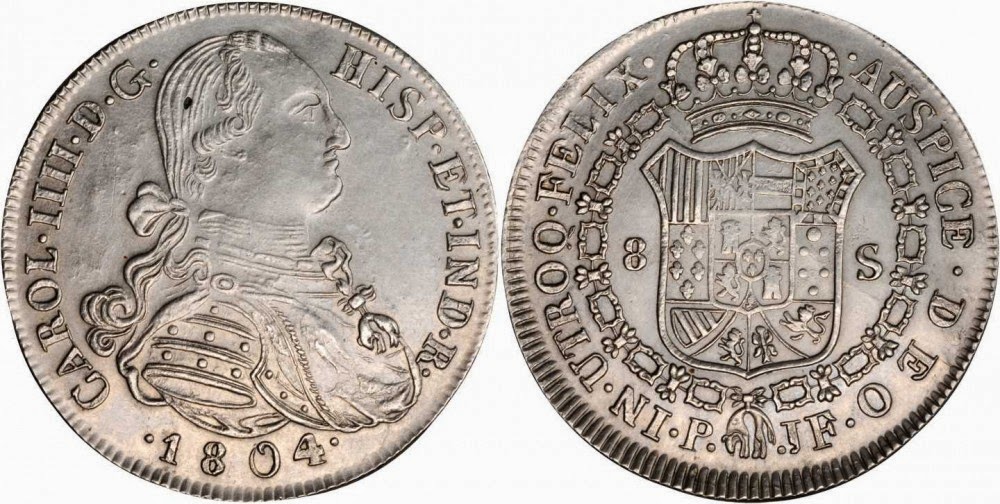
At full weight, the Carlos IV ("IIII") 8-Escudos was 27.07 g, .875 fine gold, 36.40 mm diameter. A circulated 8-Escudos might weight ~ 26.85 g. 


This 1804 contemporary 8-Escudos counterfeit (Popayan mintmark. JF assayer: Fr-52; KM-62.2) in Platinum was about Uncirculated: 36.5 mm. 1.5 mm thick. 26.68 g.

The Surface Area of this particular Platinum Counterfeit (+0.05, in relief) was ~22.7 cm²

 At full weight, this coin would presumably have at least an additional 0.443 g Gold surface, ~6.8 Grains Troy.

Sold at Stack’s Bowers and Ponterio Schaumburg Sale, 'Bella Collection Part l' 6/25/2009: USD$ 3,450 ; Spot 

Sold at Stack’s Bowers and Ponterio January 2014 NYINC Auction, Session A 1/10/2014:  
USD$ 3,819 (+17.5%?) ; Spot

Offered by the Florida Gold Coin Exchange in mid July 2014 for USD$ 7,500. 


This 1804 contemporary counterfeit (Potosi, Bolivia. PJ assayer) in Platinum, slightly inaccurate design, was about Fine: 36.5 mm. 1.5 mm thick. 26.7 g.  At full weight, this coin would presumably have at least 0.395 g Gold surface, 6 Grains Troy.

Sold at Sedgewick (FL) October 25, 2012:  
USD$ 3,535 (total, premium & 7% tax) ; Bullion Spot $ 1,572. ; Coin Spot

(For comparison, a circulated 1804 8-Escudo coin in lightly worn condition weighed 26.98 g See: Ca. 111; Cy. 14587; HSA 1001.1.25774): 11-12 years in circulation.


Contemporary counterfeit struck in ungilded platinum of a Popayan, Colombia, 2-Escudos, Charles IV, 1805SF, (Restrepo-90.23) 6.78 grams. Sold for $529 10/30/2013


Perhaps significant at certain points, the value of Spanish Dollars (and bullion generally) rose dramatically in some months, a factor inflating/distorting commodity prices from the Spanish Main, certainly.