Showing posts with label Choco. Show all posts

June 25, 2013

Colombia, 1825 -1850


http://books.google.com/books?id=j4EzAQAAIAAJ&pg=PA157&dq=arroba+colombia&hl=en&sa=X&ei=UCPXUZaFNvfH4AOLtoHgBw&ved=0CDcQ6AEwAA#v=onepage&q=price%20&f=false


c.1822:
Reported in the early 1830s, Colombian Gold mines were "neglected in the more general search for platina" during the (early) 1820s.  Citing Cochrane (c.1824) elsewhere;

Citation: An Accompaniment to Mitchell's Map of the World, on Mercator's Projection...; Samuel Augustus Mitchell (1846) p.272
 

1825:

1825:  1 kg. US Flour @ =  S$ 0.72 -1.01/kg.


1825:  1 kg. (local) Beef @ Chocó (whols.)=  S$ 0.5435


Citation: An Encyclopaedia of Geography Vol 4, Hugh Murray (1834) p.1406
 

1837:  1 kg. (local) Beef @ Bogotá (whols.)=  S$ 0.08 - 0.09

1837:  1 kg. (local) Mutton @ Bogotá (retail)=  S$ 0.06
1837:  1 Fowl @ Bogotá (retail)=  S$ 0.01 - 0.15
1837:  1 Turkey @ Bogotá (retail)=  S$ 0.03 - 0.06
1837:  1 Liter Madeira @ Bogotá (retail)=  S$ 2.113
1837:  1 Liter brandy @ Bogotá (retail)=  S$ 1.8489
1837:  1 Liter English Porter @ Bogotá (retail)=  S$ 0.7042
1837:  1 kg. (local) Beef @ Bogotá (retail)=  S$ 0.1359
1837:  1 kg. (local) Mutton @ Bogotá (retail)=  S$ 0.1020
1837:  1 Dozen Eggs @ Bogotá (retail)=  S$ 0.1875
1837:  1 kg. Tea @ Bogotá (retail)=  S$ 6.5217
  
1837: 


Transport:


1837: 1 pair locally-made 'Wellington' boots = S$ 10.
1837: 1 pair locally-made poor-quality boots = S$ 2.


1822:  1 kg. Salt @ Zipaquira= S$ 0.065


Puerto Nare?

1837:  1 Dozen Eggs @ Nare (retail)=  S$ 0.25


Export Values, 1837:


1845: 
Where Wheat @ 13.5% moisture = 60 lbs. avd. = 27.2155 kg = $S 3.375, 
1845: 1 kg 'best wheat' @ Bogota = S$ 0.1240 (£ 0.0248)
1845: 1 lb avd. 'best wheat' @ Bogota = S$ 0.0565  (£ 0.0113)


c.1847? 
c. 1847:  1 kg. Rice @ Chocó  ~S$ 0.3478


c. 1847:  1 kg. Potatoes @ Chocó  S$ 0.4348


c.1850: Colombian Balsams


Bogota  to New York/Philadelphia: ~3,000 miles by sea & land routes
(2,510 miles)


June 7, 2013

Russia, 1827

As Kancrin estimates, if the Russian Government paid 5,790.72 руб Acc. per Poud, the SPb Mint price for ore at .70 Fine Pt was 353.51 руб Acc./Kg (= £ 14.73; Fr 377.36; USD$ 72.85-73.42) with no tax/levy factored.

If the Mint cost, as noted, was 6,714.24 руб Acc. per Poud, the SPb Mint the first base cost for 'pure' Pt was 409.89 руб Acc./Kg (= £ 17.08; Fr 437.55; ~USD$ 84.47-85.13).

Kancrin also estimated the London Price of Platinum @ 771.62 руб Acc./Kg (£ 32.15)
 
If the Russian Government paid 2,300 руб Acc. per Poud, Kancrin's estimate was wildly mistaken; instead, it appears the 20th C. observers have misstated and miscalculated the contemporary Banco/Silver Rouble rates.   

From Kancrin's cost estimate for 70% ore, delivered at SPb: 1,372.57 руб Ag, or 83.79 руб Ag/Kg.; and for refined 1,591.47 руб Ag, or 97.16 руб Ag/Kg.

By the Russian Poud, 1 Kg. Platinum at the SPb Mint was sold @ 1,172.13 руб Kr in 1827.
.... 1 Kg SPb Platinum (8/1827) = £ 48.84;  Fr 1,251.20 ; ~USD$ 241.55 - 243.44
 

c.1827: 1 Troy Ounce platina (SPb)= 4.3673 руб Acc. (1.1704 руб Ag)

Citation: Transactions of the Institution of Mining and Metallurgy, Vol. 21 (1912) p.650


c.1827-1832: 1 Troy Oz. Platinum (SPb)= 34.18 руб Acc. (9.18 руб Ag)


Qiring's estimate errs in calculating the Silver Rouble rate.

Citation: Die metallischen rohstoffe, ihre lagerungsverhältniss und ihre wirtschaftliche bedeutung..., Vol. 16 (1962) Heinrich Quiring
 
"1826/27 wurde in St. Petersburg Rohplatin mit 171.5 Rubel, reinplatin mit 283 Rubel je kg. bewertet." 

 
Citation: Bulletin universal des sciences et de líndustrie..., Vol. 9 (1828) p.3

 
July, 1827:
7/27: 1 Troy Ounce platina (SPb: 71.37% pure) ~ 15.61 руб Acc. ~ 4.19 руб (Ag)
  
7/27: 1 Troy Ounce platina (SPb)= 21.87664 руб Acc. ~ 5.873 руб (Ag)
7/27: 1 Troy Oz. Pt (SPb: refining 'cost') ~ 7.292 руб Acc. ~ 1.9575 руб (Ag)
7/27: 1 Troy Oz. Pt (SPb: refining price) ~ 11.303 руб Acc. ~ 3.0342 руб (Ag)
7/1827: 1 Troy Oz. Pt (SPb, sponge) = 29.16885 руб Acc. ~ 7.83 руб (Ag)
7/1827: 1 Troy Oz. Pt (SPb: semi-mfg) = 36.46107 руб Acc. ~ 9.7875 руб (Ag)


July, 1827: 1 Troy Oz. Platinum (Paris retail) = 32.16 руб Acc. ~ 8.633 руб (Ag)

From von Humboldt's data, Count Kankrin estimated the average Chocó platinum yield to be  20,012.5 ozt (~622.5 kgs.) Kankrin also estimated the platina purity at 71.36735%, so  

1827: 1 Troy Oz. Platinum (Cost Basis) = 17.866 руб Acc. ~4.796 руб (Ag)

He estimated the Platinum value at 4.41 руб Banco per Solotnik (equivalent to the Paris Price) so: 


1827: 1 Troy Oz. Platinum (cited UK Price) = 24. руб Acc. ~6.44 руб (Ag)   
1827: 1 Troy Oz. Platinum (Cancrin's est.) = 32.16 руб Acc. ~ 8.633 руб (Ag)   
1827: 1 Troy Oz. platina (miner cost, at purity) = 11 руб Acc. ~ 2.95 руб (Ag)  
1827: 1 Troy Oz. Pt (refiner cost) = 1.75 руб Acc. ~ 0.47 руб (Ag)  
1827: 1 Troy Oz. Platinum (First Base Cost) = 12.75 руб Acc. ~ 3.423 руб (Ag)

1827: Miner Cost (Russia)  = £ 0.4584 ; Fr 11.74  
1827: Refiner Cost (Russia) =  £ 0.0731 ; Fr 1.872  
1827: First Base Cost (Russia) =  £ 0.5315 ; Fr 13.612  
1827: 1 Troy Oz. platina (SPb: 80% pure) = £ 0.73 ; Fr 18.70 
1827: 1 Troy Oz. platina (SPb: at purity) = £ 0.9115 ; Fr 23.34  
1827: 1 Troy Oz. Pt (SPb, sponge) = £ 1.215 ; Fr 31.12
1827: 1 Troy Oz. Pt (SPb, semi-mfg) = £ 1.519 ; Fr 38.90 

"It is not likely that the expected global supply of Platinum will even increase much, because after your own estimation of the gold-yield from Choco is 10,800 marks, assuming a full third of which is Platina, will come out to about 3,000 marks, or nearly 38 pouds."

Citation: Im Ural und Altai: Briefwechsel zwischen Alexander von Humboldt und Graf ...Alexander von Humboldt, Egor F. Kankrin


"In any case, it's unlikely to suddenly happen that the collapsing value of platina and Münzemanation (coin debasement?) can be circumstantially foreseen. Therefore, I believe that no interfering coin confusion could arise."


"How have I valued the coin? Platina to silver is calculated at '5 to 1.'  The value of legal Rouble-weight in Platinum would be 5.7526 Roubles (this deviates from the calculations of the last letter somewhat) and with seigniorage of approximately 24 Kopecks per Six Silver Roubles; half Rouble-weight so 3 Roubles, and this should be the smallest coin struck.  Platinum would then be worth to 4.41 руб Banco per Zolotnik, and therefore isn't excessively profitable over the mining cost.

In the case that the proportion of 5 to 1 would be too high, I would have suggested of 4.25, where the weight Platinum would make 5 Roubles silver, but that would puts Zolotnik at 3.75 Roubles Banco. This coin is not as uncomfortable as it was only the size of half a Rouble; beat to a 2.5, but it would not quite fit.

If both ratios to be high, it might be to go even safer, the Rouble weight Platina to 4 and take half to 2 Roubles silver coin. This would be the proportion of 3.25 to 1, the value of 3.74 rubles weight fraudulent rubles silver coin and a seigniorage of 26 Kopecks, 4 rubles, ie 2 half rubles, a very suitable coin.  In paper this would be 2.865 руб Banco per Solotnik, which still came out a little advantage, or no one would give his Platina to be coined. You can broadly estimate production of 10 Solotniks raw Platina costs 15.08 руб Banco.  The cleaning cost is about 2.405 руб Banco, 17.485 руб Banco in total.  The pure Platinum obtained will be 7  Solotniks, so pure Platinum comes to 2.495 руб Banco per Solotnik.   Against the 3.25:1 ratio, the profit, except for Seigniorage, is therefore only 0.37 руб Banco.

However, contrary to this insignificant profit trade prices. After just received news from London Platina troy ounce can be sold in bars for twenty shillings, which account for about 24 rubles paper. After that, the Solotnik such Platina would come to 3.29 Rubles paper. The value of silver is o.23703 руб Banco per Solotnik, so the relation of Platina to silver would be in this case as 3.73:1. It follows that the proportion of 3.25:1 is too low."


1827 Platina Yield (at Mint Price, Retail)
13,561 Ozt :  296,638 руб Acc. = 79,499 - 79,849 руб Ag 

.... @ £ 0.1542 руб Ag: £ 12,256 - 12,310 ; @ £ 0.0427 руб Acc. : £ 12,669

1827: 1 Troy Oz. platina  = £ 0.9038 - £ 0.9342

Citation: Narrative of a Visit to the Courts of Russia and Sweden: In the Year 1830 & 1831, Vol. 2;  Charles Colville Frankland (1832)


Citation: St. Petersburgh, a journal of travels to and from that capital, Vol. 2;  Augustus Bozzi Granville (1828) p.158


'Common platina' bluish tint: Specific Gravity of 17. - 17.61 = ~72% Pt

Better quality nuggets (Specific Gravity of 19.17) were 80.9% Pt, 11.07% Rh, 1.64% Pd  


No. 1:  A Platinum Pattern-piece, struck on the Rouble Die (1827?)
Weight: 8 Sol. 42 Th. (35.99 g. = 1.572 Ozt) -- The Onza was 28.76g. ; 0.92466 Ozt)

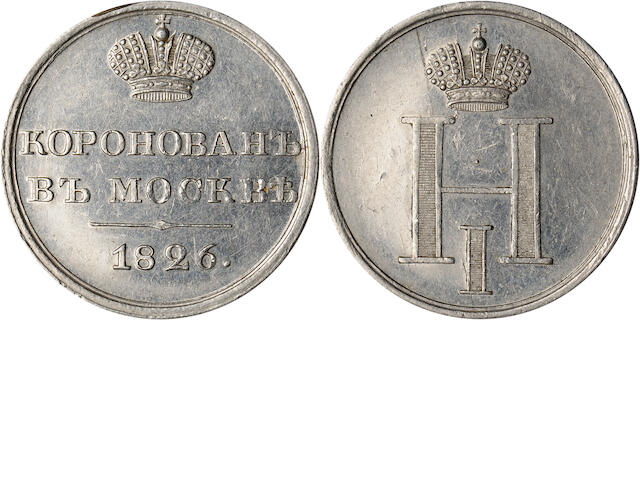
No. 8: The largest Coronation Medal.  

Perhaps Bonham's 8 Dec 2010, Auction 18404 Lot 1034: a Coronation Medal weighing 15.6 g sold for USD$ 12,870 (incl premium) 1,388.4% over Spot.

https://images2.bonhams.com/image?src=Images/live/2010-08/09/8133435-3-2.jpg&width=640&height=480&halign=l0&valign=t0&autosizefit=0 Citation: Im Ural und Altai Alexander von Humboldt (1869) p.5


Found in 1827, reported in Europe February 1828.

1836: Russian 10.5625 Funt = 4.326 Kgs (9.536 Lbs avd.) ~66% Pt, ~68% PGMs


June 1827: The largest platina mass then found, 4.33 kgs (~12 English Troy Pounds, 139 Ozt)


Largest Nugget 'yet discovered' in June 1827, reported in St. Petersburg August 1827 (+1.5 months), Southern Germany (+2 months), in London October 1827 (+3.5 months), on the Eastern seaboard USA by January 1828 - a delay of +7 months.  

The 1827 Nugget weighed 10.5625 фунт (139.067 Ozt; 4.3255 Kgs) at 50% Pt


Still described & reported by travelers as "the largest nugget," as late as 1835 (1838)


Außerordentliche Beilage zur Allgemeinen Zeitung 1827. Nr. 43. (12/8/1827)
Von den in Sibirien aufgefundenen gediegenen Platina-Massen.

Extra Supplement to the Allgemeine Zeitung in 1827. No. 43  (12/8/1827)
On the discovery in Siberia of solid platina nuggets.


1827 Platinum Yield of Urals, as reported in 1829: 
13,557 Ozt. = 25.74 Pouds

1827: 1 Troy Oz. Platinum (SPb) ~ руб Acc 9.85 - 10.09 (£ 0.420447)


1827: 16.564 Pouds ~8,723 Oz, ~ 271.33 Kgs.

Citation: The Encyclopaedia Britannica: Or, Dictionary of Arts..., Vol. 7; Vol. 15 (1842) p.254


Purity of Ural platina


1827: Purity of platina sold at SPb Mint: 81%


September 13, 2012

Colombia, 1814

1814: 1 Troy Ounce platina (Est. Choco Spot) ~ S$0.1014 (£ 0.0225)
1814: 1 Troy Oz. platina (Est. Cartagena Spot) ~ S$0.1352 (£ 0.03)

Dr. Erich Bollman quoted a purported Cartagena platina price a of S$ 5./libra in 1814. 
Had Bollman's information had been correct, the profit margin between Cartagena and Philadelphia would have been just 22%. 

In 1823, Cochrane (1824) indicates that Gold was 25% more valuable in Kingston than in Cartagena. Logically, bulk platina was sold cheaper to British merchants in Kingston than Bollman's quote in 1813/4:  perhaps ~S$ 4. /libra.  So intuitively, Bollman's price-quote was the Jamaica-rate, where 'Kingston to Philadelphia' trade allowed +S$1./oz Troy marginal profit.  Likewise, Cartagena to Kingston was +S$1./oz Troy, ~33% or fair markup.   

Therefore, the Cartagena bid must have been even lower, a Colombian Price-Low. 
When platina was sold in London for 3s/oz. Troy,  it was 5x the Choco Spot-Price.  See Chaldecott (PMR 1983, Vol. 27, No. 2, p.81):

"[In August 1814, Bollman] told Wollaston that supplies of crude platinum could be obtained from the merchant firm Adams, Robertson &Co. of Kingston, Jamaica, and that smuggled ore could not be bought at Cartagena for less than five Spanish dollars a pound (libra) equivalent to 1s. 6d. an ounce troy, and that the price at Philadelphia was six dollars (6)."  

"S$5." ÷ 14.7946 Ozt. (often, 1 libra = 14.792 English Troy Oz.) = S$0.3380 = "1s. 6d." (£0.0750) assumes an exchange of 4s. 5.25d. (or £1. = $4.5062), a relatively high rate against the Pound. 

1814: 1 Troy Oz. platina (Choco: Estimate) ~ S$0.1014 - 13.52 (£ 0.0225 - 0.03)
1814: 1 Troy Oz. platina (Cartagena: Est.) ~ S$0.2704 (£ 0.06 = '1s. 2.35d') )

1813/4: 1 Troy Oz. platina (Jamaica Price) = S$0.338 (£ 0.075)
1813/4: 1 Troy Oz. platina (Philadelphia: bulk, ore) = USD$ 0.4115 (£ 0.0833)

1814: 1 Troy Oz. platina (London: whols., ore) = £ 0.15 (S$ 0.6758) 

1814: 1 Troy Oz. platina (Colombia: Est. Specimen Rate) ~ S$0.4056 - 0.5 (£ 0.09 - 0.12)

Also:
1813/4: 1 Troy Oz. Platinum (Producer Cost, $15./lb. avd) = USD $1.029 (£ 0.2207)


Where 13,960 Marcos of .880 Gold Ore = 180,660 Ozt Fine Gold in 1814.


Citation: L'Europe et ses Colonies en Decembre 1819, Vol. 1; M. Beaumont de Brivazac (1820) p.219


Local merchants accumulated & traded large quantities of platina in exchange for low-quality English goods acquired at subsidized rates.


A large platina nugget was found in 1814, taken by Spanish authorities in October 1816, transported to Spain in late 1817, and first reported publicly in early May 1818.  That discovery suggests two important points relevant to the Colombian platina yield of 1814, which may have signaled a Price-Low in that year.

1) 'Record-setting' nuggets were typically found in rich placers, during seasons with a extraordinarily high mineral yields.

2) The presentation of platina to the Commanding General of the Spanish Armies, in a time of war, suggests that mineral was instrumental in funding the attempted Reconquista.    

It is especially ironic that General Pablo Morillo was lauded as a protector of scientific discoveries.  Morillo gained infamy in 1816 for ordering the execution of intellectuals such as the Colombian scientist, Francisco José de Caldas (who had traveled with Alexander von Humboldt, in 1801).  Morillo's terse repudiation of pleas for clemency sounded a proto-fascist note: "España no necesita sabios."

Assuming Castillan weight as first reported, the 'Hurtado pepita' weighed 23.23 English Troy Ounces or 722.2 grams. 

Madrid, 1818: news from London took ~3 weeks; from from St. Petersburg, ~8 weeks; from Venezuela ~14 weeks (3.5 months).

Whereas merchant price-currents followed normal shipping times, general knowledge of foreign data was delayed until summary or re-publication in journals.  This Madrid news item was reported by English scholarly journals 6 months later.   (The actual specimen discovery in Choco had occurred four years earlier.)

Citation: Gaceta de Madrid, No. 53, p. 442 (May 2, 1818) : 

Citation: El Español constitucional: Ó miscelanea de política, ciencias y ..., Vol. 1 (Oct. 1818 ) p.136

Citation: The Philosophical Magazine and Journal, Vol. 52, No. 247  Andrew Tilloch(Nov. 1818) p.382


Citation: Travels through the interior provinces of Columbia [sic], Vol. 2 John Potter Hamilton


1824: In Colombia, Specimen-Gold was sold at the 'market price for Gold' (presumably, coined rate) notwithstanding intrinsic value nor impurities.  Specimen-platina likely sold to European travelers at similarly inflated 'retail' rates, in both earlier & later periods.


Bonnycastle's work was a compendium; he was never in Colombia.  The uncertain reference for this price may be the 1817 French dictionary which also reproduced dated information.

Taking the French Franc at Fr 1.23 per English Shilling in December 1814:

33 Shillings per Libra = 32.54 s.  per Pound Avd. = £3.5869 per Kg. (~72 s.) ;
Fr. 40.59 per Libra = Fr 40.02 per Pound Avd. = Fr. 88.56 per Kg.

1814?: 1 Troy Ounce platina (raw ore, in Colombia) =  £ 0.1116 (Fr 0.25)

Citation:  Spanish America: or A descriptive, historical, and geographical account of ... By Sir Richard Henry Bonnycastle 1818, p.274

c. 1814?
Citation: Nouveau dictionnaire d'histoire naturelle, appliquée aux arts, à ..., Vol. 26 (1817) p.583

Citation: Colombia: being a geographical, statistical, agricultural, commercial, and ... Alexander Walker (1822) p.312

Where .750 Gold was S$ 200. per libra, Fine Gold .9999 was S$ 267./libra.
Where 'poor Gold price was S$ 37.50 - S$ 75. per libra and 'oro bajo' the fineness may be assumed less than 35%.

Platina was sometimes found to be 50/50 Au-Pt:

Citation: Proceedings of the Second Pan American Scientific Congress, Washington, USA ; Glen Levin Swiggett p.331


Platinum/Gold Ratio on the Condo River was 3:1


1817: In this account, General Morillo's henchman and chief-of-staff, Pascual Enrile, was blamed for much of the butchery and the liquidation of Colombia's scientists & intellectuals.

Citation: Estudio cronologico de la guerra de la independencia de la antigua Colombia ;  Nicolas González Chaves (1879) p.551

Colombians viewed the export of these treasures as little more than Crown theft.