Showing posts with label Humboldt. Show all posts

June 7, 2013

Russia, 1827

As Kancrin estimates, if the Russian Government paid 5,790.72 руб Acc. per Poud, the SPb Mint price for ore at .70 Fine Pt was 353.51 руб Acc./Kg (= £ 14.73; Fr 377.36; USD$ 72.85-73.42) with no tax/levy factored.

If the Mint cost, as noted, was 6,714.24 руб Acc. per Poud, the SPb Mint the first base cost for 'pure' Pt was 409.89 руб Acc./Kg (= £ 17.08; Fr 437.55; ~USD$ 84.47-85.13).

Kancrin also estimated the London Price of Platinum @ 771.62 руб Acc./Kg (£ 32.15)
 
If the Russian Government paid 2,300 руб Acc. per Poud, Kancrin's estimate was wildly mistaken; instead, it appears the 20th C. observers have misstated and miscalculated the contemporary Banco/Silver Rouble rates.   

From Kancrin's cost estimate for 70% ore, delivered at SPb: 1,372.57 руб Ag, or 83.79 руб Ag/Kg.; and for refined 1,591.47 руб Ag, or 97.16 руб Ag/Kg.

By the Russian Poud, 1 Kg. Platinum at the SPb Mint was sold @ 1,172.13 руб Kr in 1827.
.... 1 Kg SPb Platinum (8/1827) = £ 48.84;  Fr 1,251.20 ; ~USD$ 241.55 - 243.44
 

c.1827: 1 Troy Ounce platina (SPb)= 4.3673 руб Acc. (1.1704 руб Ag)

Citation: Transactions of the Institution of Mining and Metallurgy, Vol. 21 (1912) p.650


c.1827-1832: 1 Troy Oz. Platinum (SPb)= 34.18 руб Acc. (9.18 руб Ag)


Qiring's estimate errs in calculating the Silver Rouble rate.

Citation: Die metallischen rohstoffe, ihre lagerungsverhältniss und ihre wirtschaftliche bedeutung..., Vol. 16 (1962) Heinrich Quiring
 
"1826/27 wurde in St. Petersburg Rohplatin mit 171.5 Rubel, reinplatin mit 283 Rubel je kg. bewertet." 

 
Citation: Bulletin universal des sciences et de líndustrie..., Vol. 9 (1828) p.3

 
July, 1827:
7/27: 1 Troy Ounce platina (SPb: 71.37% pure) ~ 15.61 руб Acc. ~ 4.19 руб (Ag)
  
7/27: 1 Troy Ounce platina (SPb)= 21.87664 руб Acc. ~ 5.873 руб (Ag)
7/27: 1 Troy Oz. Pt (SPb: refining 'cost') ~ 7.292 руб Acc. ~ 1.9575 руб (Ag)
7/27: 1 Troy Oz. Pt (SPb: refining price) ~ 11.303 руб Acc. ~ 3.0342 руб (Ag)
7/1827: 1 Troy Oz. Pt (SPb, sponge) = 29.16885 руб Acc. ~ 7.83 руб (Ag)
7/1827: 1 Troy Oz. Pt (SPb: semi-mfg) = 36.46107 руб Acc. ~ 9.7875 руб (Ag)


July, 1827: 1 Troy Oz. Platinum (Paris retail) = 32.16 руб Acc. ~ 8.633 руб (Ag)

From von Humboldt's data, Count Kankrin estimated the average Chocó platinum yield to be  20,012.5 ozt (~622.5 kgs.) Kankrin also estimated the platina purity at 71.36735%, so  

1827: 1 Troy Oz. Platinum (Cost Basis) = 17.866 руб Acc. ~4.796 руб (Ag)

He estimated the Platinum value at 4.41 руб Banco per Solotnik (equivalent to the Paris Price) so: 


1827: 1 Troy Oz. Platinum (cited UK Price) = 24. руб Acc. ~6.44 руб (Ag)   
1827: 1 Troy Oz. Platinum (Cancrin's est.) = 32.16 руб Acc. ~ 8.633 руб (Ag)   
1827: 1 Troy Oz. platina (miner cost, at purity) = 11 руб Acc. ~ 2.95 руб (Ag)  
1827: 1 Troy Oz. Pt (refiner cost) = 1.75 руб Acc. ~ 0.47 руб (Ag)  
1827: 1 Troy Oz. Platinum (First Base Cost) = 12.75 руб Acc. ~ 3.423 руб (Ag)

1827: Miner Cost (Russia)  = £ 0.4584 ; Fr 11.74  
1827: Refiner Cost (Russia) =  £ 0.0731 ; Fr 1.872  
1827: First Base Cost (Russia) =  £ 0.5315 ; Fr 13.612  
1827: 1 Troy Oz. platina (SPb: 80% pure) = £ 0.73 ; Fr 18.70 
1827: 1 Troy Oz. platina (SPb: at purity) = £ 0.9115 ; Fr 23.34  
1827: 1 Troy Oz. Pt (SPb, sponge) = £ 1.215 ; Fr 31.12
1827: 1 Troy Oz. Pt (SPb, semi-mfg) = £ 1.519 ; Fr 38.90 

"It is not likely that the expected global supply of Platinum will even increase much, because after your own estimation of the gold-yield from Choco is 10,800 marks, assuming a full third of which is Platina, will come out to about 3,000 marks, or nearly 38 pouds."

Citation: Im Ural und Altai: Briefwechsel zwischen Alexander von Humboldt und Graf ...Alexander von Humboldt, Egor F. Kankrin


"In any case, it's unlikely to suddenly happen that the collapsing value of platina and Münzemanation (coin debasement?) can be circumstantially foreseen. Therefore, I believe that no interfering coin confusion could arise."


"How have I valued the coin? Platina to silver is calculated at '5 to 1.'  The value of legal Rouble-weight in Platinum would be 5.7526 Roubles (this deviates from the calculations of the last letter somewhat) and with seigniorage of approximately 24 Kopecks per Six Silver Roubles; half Rouble-weight so 3 Roubles, and this should be the smallest coin struck.  Platinum would then be worth to 4.41 руб Banco per Zolotnik, and therefore isn't excessively profitable over the mining cost.

In the case that the proportion of 5 to 1 would be too high, I would have suggested of 4.25, where the weight Platinum would make 5 Roubles silver, but that would puts Zolotnik at 3.75 Roubles Banco. This coin is not as uncomfortable as it was only the size of half a Rouble; beat to a 2.5, but it would not quite fit.

If both ratios to be high, it might be to go even safer, the Rouble weight Platina to 4 and take half to 2 Roubles silver coin. This would be the proportion of 3.25 to 1, the value of 3.74 rubles weight fraudulent rubles silver coin and a seigniorage of 26 Kopecks, 4 rubles, ie 2 half rubles, a very suitable coin.  In paper this would be 2.865 руб Banco per Solotnik, which still came out a little advantage, or no one would give his Platina to be coined. You can broadly estimate production of 10 Solotniks raw Platina costs 15.08 руб Banco.  The cleaning cost is about 2.405 руб Banco, 17.485 руб Banco in total.  The pure Platinum obtained will be 7  Solotniks, so pure Platinum comes to 2.495 руб Banco per Solotnik.   Against the 3.25:1 ratio, the profit, except for Seigniorage, is therefore only 0.37 руб Banco.

However, contrary to this insignificant profit trade prices. After just received news from London Platina troy ounce can be sold in bars for twenty shillings, which account for about 24 rubles paper. After that, the Solotnik such Platina would come to 3.29 Rubles paper. The value of silver is o.23703 руб Banco per Solotnik, so the relation of Platina to silver would be in this case as 3.73:1. It follows that the proportion of 3.25:1 is too low."


1827 Platina Yield (at Mint Price, Retail)
13,561 Ozt :  296,638 руб Acc. = 79,499 - 79,849 руб Ag 

.... @ £ 0.1542 руб Ag: £ 12,256 - 12,310 ; @ £ 0.0427 руб Acc. : £ 12,669

1827: 1 Troy Oz. platina  = £ 0.9038 - £ 0.9342

Citation: Narrative of a Visit to the Courts of Russia and Sweden: In the Year 1830 & 1831, Vol. 2;  Charles Colville Frankland (1832)


Citation: St. Petersburgh, a journal of travels to and from that capital, Vol. 2;  Augustus Bozzi Granville (1828) p.158


'Common platina' bluish tint: Specific Gravity of 17. - 17.61 = ~72% Pt

Better quality nuggets (Specific Gravity of 19.17) were 80.9% Pt, 11.07% Rh, 1.64% Pd  


No. 1:  A Platinum Pattern-piece, struck on the Rouble Die (1827?)
Weight: 8 Sol. 42 Th. (35.99 g. = 1.572 Ozt) -- The Onza was 28.76g. ; 0.92466 Ozt)

No. 8: The largest Coronation Medal.  

Perhaps Bonham's 8 Dec 2010, Auction 18404 Lot 1034: a Coronation Medal weighing 15.6 g sold for USD$ 12,870 (incl premium) 1,388.4% over Spot.
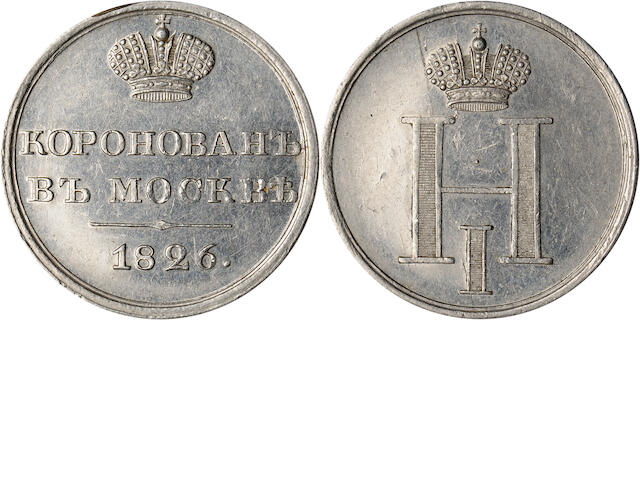
https://images2.bonhams.com/image?src=Images/live/2010-08/09/8133435-3-2.jpg&width=640&height=480&halign=l0&valign=t0&autosizefit=0 Citation: Im Ural und Altai Alexander von Humboldt (1869) p.5


Found in 1827, reported in Europe February 1828.

1836: Russian 10.5625 Funt = 4.326 Kgs (9.536 Lbs avd.) ~66% Pt, ~68% PGMs


June 1827: The largest platina mass then found, 4.33 kgs (~12 English Troy Pounds, 139 Ozt)


Largest Nugget 'yet discovered' in June 1827, reported in St. Petersburg August 1827 (+1.5 months), Southern Germany (+2 months), in London October 1827 (+3.5 months), on the Eastern seaboard USA by January 1828 - a delay of +7 months.  

The 1827 Nugget weighed 10.5625 фунт (139.067 Ozt; 4.3255 Kgs) at 50% Pt


Still described & reported by travelers as "the largest nugget," as late as 1835 (1838)


Außerordentliche Beilage zur Allgemeinen Zeitung 1827. Nr. 43. (12/8/1827)
Von den in Sibirien aufgefundenen gediegenen Platina-Massen.

Extra Supplement to the Allgemeine Zeitung in 1827. No. 43  (12/8/1827)
On the discovery in Siberia of solid platina nuggets.


1827 Platinum Yield of Urals, as reported in 1829: 
13,557 Ozt. = 25.74 Pouds

1827: 1 Troy Oz. Platinum (SPb) ~ руб Acc 9.85 - 10.09 (£ 0.420447)


1827: 16.564 Pouds ~8,723 Oz, ~ 271.33 Kgs.

Citation: The Encyclopaedia Britannica: Or, Dictionary of Arts..., Vol. 7; Vol. 15 (1842) p.254


Purity of Ural platina


1827: Purity of platina sold at SPb Mint: 81%


August 10, 2012

Colombia, 1801

Contraband platina came to market at coastal ports like Cartagena and Guayaquil from slaves, creole traders, local capitalists and perhaps even Crown employees at local Spanish Mints.  Where sporadic smuggling from such diverse sources/networks supplied varying quantities (from small lots to bulk) to English merchants, it's impossible to reconstruct with any certainty an accurate chronological price record in Chocó, Cartagena, etc.  

The true average Spot-Price for Colombian platina would be the weighted average of platina transactions over a month or season or year, at the source and Cartagena. This unknown price fluctuated in months, seasons and years on a variety of supply/demand factorsBut in any market, small lots of best-grade ore probably cost more than bulk lots of low-quality, iron-rich, smaller granules.  It is also possible platina was used as currency for town-merchants' goods; this qualitative or intrinsic differential (monetary platina value, in what is now Colombia) remains likewise unknown, without any accurate base price.
 
The famous explorer and scientist Alexander von Humboldt visited Chocó in October 1801 and purchased specimen platina.  His visit to the platina district was well-publicized and reported in Europe by Dutch journals in August 1803.  In 1809 and later manuscripts, von Humboldt's spott-preis was commonly mis-stated as a 'Chocó spot-price' for at least two decades ("in 1823" etc.) thereafter  

It's worth noting that von Humboldt subsequently (1826) revised this data, recording a much lower spott-preis when demand and local prices were record-high (1825: S$10./libra @ Chocó;  S$16.-20. @ Cartagena) and during the 1825 Price-Spike in Europe.  

The [1801] price of this metal in grain on the spot is 8 piastres or 40 Francs to the pound, while at Paris [1809?] is it generally 130 to 150 Francs" 

The "piastre" or "dollar" is the globally traded silver coin known locally as the peso fuerte or peso of 8 reals (374.87 English Troy grains, 24.29 grams of Fine Silver.)  For merchants, the Colombian "pound" is the Spanish libra (460 grams = 14.792 English Troy Ounces, close to the standard English Pound avoirdupois) whereas in France a different standard-weight persisted for precious metals, the Poid du Marc (489.5 grams = 15.74 English Troy Ounces.) 

Beyond an obvious weight discrepancy, von Humboldt's comparative price entails certain problematic elements.  The German scientist purchased small amounts of specimen platina at a much higher cost than professional traders actually purchased bulk ore.   Wholesale-, or trader's spot-price at Chocó was an (unknown) average price at which platina was forward-traded by area miners to Cartagena merchants to cover debts, as with Gold dust.  Hypothetically, the Spot-Price Gold-dust was ~25% less than the Mint-price or market-rate at the port; bulk platina may have been discounted more. The true average price is unknown, by Colombian sources (1803) report the stockpiling of platina in Chocó.

Obviously, von Humboldt's spott-preis is too high. How else could British merchants have sold platina at lower prices in Jamaica, or at cost in London?  This is readily understood since platina was sold in London at nearly the same price (in Silver.)  Less than a year earlier Dr. William Hyde Wollaston paid the same rate in bulk to dealers in London.  If British merchants paid von Humboldt's price for small lots, they'd have suffered a ruinous trade-loss, after all expenses (portage, shipping and insurance, bribes, middle-man fees, profit margins, etc.) to European markets.  The price given by von Humboldt was therefore the 'known foreigner money price' for better platina at Cartagena.  

The question remains how to estimate the bulk Spot-Price at Chocó, given various reported numbers in proximate years.  (Incidentally, it's reasonable to surmise that Dr. Wollaston's first lot of platina was Spanish booty seized in the Summer of 1797 and sold at auction in England: that particular lot may have entailed no transatlantic costs whatsoever to any Caribbean British merchants.)  If the following is correct, platina in 1800 was sold at bulk to the English for 1/25th the Price of Fine Gold.

December, 1800: 1 Troy Ounce platina (@ London, bulk) = £ 0.1344 (S$ 0.593)

October, 1801: 1 Troy Ounce platina (specimen rate @ Choco)  = S$ 0.5408
October, 1801: 1 Troy Oz. platina (specimen rate @ Choco)  =  Fr 2.704

1801: 1 Troy Oz. platina (presumed Choco Spot) ~ S$ 0.270 (£ 0.0456)
1801: 1 Troy Oz. platina (Cartagena Mkt) ~ S$ 0.4731  0.0774)


Furthermore, a time-discrepancy distorts the comparison intended: von Humboldt's 'spottpreis' is from 1801 yet his retail Paris ore price appears to be from 1807-09 (the writing of his ms.) Circa 1805-09, the export price from Cartagena was $S 6./libra on average; average Chocó prices must have been significantly lower, not higher. 

Conflating 'specimen' and retail versus wholesale or import (bulk) prices, it's difficult to presume a stable, range-bound Paris retail price for ore at the same time the Colombian spot-price declined dramatically.  (Incidentally, the Paris platina price appears to have collapsed over 50% around 1811, the year the ms. was first published.)   Against (low) refined French Platinum prices in 1811, von Humboldt's platina prices are suspect, inconclusive.  At a premium of "Spanish Dollars" (Pesos Duro, Plate = and the local weight (not avoirdupois), 'retail' Chocó price is 26% - 31% (one-quarter to one-third) retail Paris price.   

In London (December 1800) William Hyde Wollaston  paid almost the same rate as von Humboldt's alleged Chocó Spot-Price just ten months later.  The English scientist's notebook consistently identifies a much lower English price: bulk prices paid fluctuating 50%, between 1802-11.  Much later, Wollaston also calculated the import mercants' ~100% profit, from 1800-1816; his own platina purchases (after shipping, middlemen profit, other costs, etc.) required lower spot-prices at Chocó for the period in question. 

Tellingly, von Humboldt suggested 25% of the Gold trade was contraband.  It's conceivable the illicit platina trade was higher, but if Wollaston was the major global producer (25%) of refined Platinum, total platina exports should be diminished accordingly.  (By assumption, there wasn't much market demand nor recorded production proving otherwise.) Chaldecott (1983) insists that no one but Wollaston was refining Platinum on a truly commercial scale in the UK.  If so, +85% of British-shipped platina from Jamaica went to Continental consumers, mostly French producers.

 "... as no one else in England at that time was able to emulate Wollaston’s success, the extent of the demand for crude platinum in England was governed almost entirely by the quantities which Wollaston alone required in order to meet the needs of his customers for malleable platinum,whether in ingot or sheet form. Much of the crude platinum used by Wollaston was obtained by John Johnson, a commercial assayer of ores and metals in London, who presumably placed orders on Wollaston’s behalf with merchants in Jamaica(3)."

Although not a well-informed calculation:
a) 8 piastres [1.08*$8.] = USD$ 8.64 at the prevailing premium on Spanish Dollars (S$)

b) 1 Colombian “pound” = 100 castellanos (1 castellano = 71 grains troy) = 7100 grains = 14.792 troy ounces,

The Chocó price 24.25-24.33 gr of 'pure' silver per Spanish Piastre: 
1 troy oz. .999 fine silver = 2.354 - 2.371 troy oz. of Chocó platina, or
(at 86.16% purity) ~ 2.028 - 2.043 troy oz. Platinum (pure ore)

1 troy oz. .999 fine gold = 35.45 - 35.7 troy oz. of Chocó platina
1 troy oz. .999 fine gold = 30.75 - 32. troy oz. Platinum (intrinsic)

1 troy oz. .999 fine gold = 30.54 - 30.76 troy oz. 'pure' Platinum, in ore
@ 7 Piastres
1 Troy Ounce platina (raw ore, in Colombia) ~ $ 0.51
1 Troy Ounce platina (raw ore, in Colombia) ~ £ 0.10
1 Troy Ounce platina (raw ore, in Colombia) ~ Fr. 2.37

@ 6 Piastres
1 Troy Ounce platina (raw ore, in Colombia) ~ $ 0.44
1 Troy Ounce platina (raw ore, in Colombia) ~ £ 0.060
1 Troy Ounce platina (raw ore, in Colombia) ~ Fr. 2.03

Where the marc of Gold (50 castellanos = 7.402 Troy Ounces) was bought at S$ 100. and valued at market, S$ 136.  Auro-platinum was probably treated as a nuisance, if not feared by merchants. The discount was likely in excess of 25%; platinum treated as waste.

1801: 1 Troy Ounce Gold (Colombia: 23 carat) = S$ 13.52
1801: 1 Troy Ounce Gold (Colombia: 10 carat?) = S$ 6.30
1801: 1 Troy Ounce Gold (Colombia: pure) = S$ 15.45

1801: 1 Troy Ounce Gold (Colombia: 21 carat) = S$ 10.14
1801: 1 Troy Ounce Gold (Colombia: pure) = S$ 11.59
1801: 1 Troy Ounce Gold (Value: pure) = S$ 18.39
1801: 1 Troy Ounce Silver (Colombia: intrinsic) = S$ 1.15

1801: 1 Troy Ounce Silver (Colombia: ore, intrinsic) = S$ 0.97

Citation: A study of the gold & silver mines of Colombia ; Vicente Restrepo

1798 FA Spanish 8 Escudos. Madrid mint. Contemporary counterfeit in platinum. EF-40. 414.2 Grains Troy, 26.83 g.

 
Boussingault (repeating von Humboldt) presumed one-third the Colombian Gold yield was exported as contraband.
Citation: Mémoires de J.-B. Boussingault, Vol. 5 ; Jean Baptiste Boussingault, Alexander von Humboldt

Citation: Estudio sobre las minas de oro y plata de Colombia ; Vicente Restrepo p.24


1814: Theoretical intrinsic value does not precisely reflect market rates, where real money traded at a premium in some periods.  In the USA throughout the period 1800 -1815, the peso fuerte was worth at least a Dollar.

The French Franc appears consistently  Fr. 5 = S$ 1.
Citation: An exposition of the commerce of Spanish America, with some observations ...   Manuel Torres (1817)


Citation: The British Critic, Vol. 40 ; Sept 1812 p.275

From his correspondence, von Humboldt was evidently in Chocó during October 1801.


Added in 1826 Edition: 1825 information


1807: The Specimen-Platinum purchased by von Humboldt in 1801 was so noteworthy to be cited in definitive English-language geographies. (Also, Pinkerton's 1804 French edition lacked this factoid.)

Citation: Modern Geography: A Description of the Empires, Kingdoms, States ..., Vol. 3 ; John Pinkerton (1807)


1824:
Citation: Journal of a residence and travels in Colombia, Vol.2 ; Charles Stuart Cochrane


Purity of platina (1905):


In 1824, free negros were paid 6 reals (S$ 0.75; £ 0.1625) per day to pan for Gold & platina; presumably, 156 reals per month (S$ 19.50).

Estimated daily wage  was ~ S$ 0.33 - 0.40 for these porters.


Colombian Weights:
1 castellano = 0.1479 English Troy Ounces
1 marco (50 castellanos; 400 tomines) = 7.3958 English Troy Ounces