June 8, 2010

Colombia 1823: Platinum Price


January, 1822: 1 Troy Ounce platina (@ Choco) = S$0.27
(Fr 1.45)
October 1823: 1 Troy Oz. platina (@ Choco) = S$0.34 (Fr 1.82)

January, 1822?: 1 Troy Oz. platina (@ Cartagena) = S$0.41 (Fr 2.91)
March, 1823: 1 Troy Oz. platina (@ Cartagena) = S$0.54 (Fr 3.65)


At Chocó, S$ 1. @£0.2750, 1 libra (S$2.) cost £ 0.55 in 1818.
At Cartagena, 1 libra (~S$ 2.85) cost ~£ 0.7838 in 1818.
 
At Chocó, S$ 1. @£0.23750, 1 libra (S$3.) cost £ 0.71875 in January 1822.
At Cartagena, 1 libra (S$4.) cost £ 0.9583 in January 1822.
 
At Chocó, S$ 1. @£0.23750, 1 libra (S$4.) cost £ 0.95 in March 1823.
At Cartagena, 1 libra (S$6.) cost £ 1.425 in March 1823.

Considering the price differentials, Mollien likely cited the Popyan/Chocó price of October 1823; the British source(s) the coastal rate.  

Citation: Voyage dans la République de Colombia: en 1823, Vol. 2  Gaspard Théodore comte de Mollien


1823: 1 Troy Oz. platina (est. avg Paris bulk) ~ Fr 10.50 - 13.30
1823: 1 Troy Oz. platina (est. avg Paris retail) ~ Fr 29.

Dated information was always dated - recognized or not. In this updated edition (July, 1826) reference to a Colombian's arrival in Paris (1825) informs von Humboldt of a more 'recent' local price (1822/3) ; see Cochrane's 1824 platina prices.

German merchant long resident in Colombia cited both much lower (S$ 2./libra) & higher (S$ 10./libra) Chocó platina prices, for 1818 and April 1826 respectively.


The Livre of 'Poid du Marc' corresponds to the bulk Libra rate at which platina was sold in Cartagena or Chocó. (Precious metals were not commonly priced in kilograms by merchants and goldworkers in this period; that would be an inconsistent comparison.)

The Spanish Dollar was generally falling at London, from £0.2417 > £0.2365.

Citation: Essai politique sur le royaume de la Nouvelle-Espagne, Vol. 3-4, ; Alexander von Humboldt p.157


Information von Humboldt received from Acosta (resident in Chocó several years earlier) was dated accordingly, c.1822/3.

Citation: Ensayo politico sobre la Nueva España, Vol. 3  Alexander von Humboldt, Vicente Gonzalez Arnao (1827) p.48


c. March, 1823: Notes on Colombia, taken in the years 1822-3: Appendix C, p. 302
"Gold Dust from Choco, 1st Quality $200 per lb.; Platinum, (crude), from $4 to 6 per lb."

January - March, 1823: 1 Troy Oz. platina (Cartagena) = S$ 0.34 - 0.61 
Jan. - Mar. 1823: 1 Troy Oz. Gold (Cartagena, .9167) = S$ 13.521 (£ 3.20 - 3.27)
Jan. 1823: 1 Troy Oz. Gold (Cartagena: intrinsic) = S$ 14.75 (£ 3.49)
  
1823: 1 Troy Oz. Gold (Cartagena) = S$ 16.90 (£ 4. - 4.08)
1823: 1 Troy Oz. Gold (Cartagena: intrinsic) = S$ 17.64 (£ 4.17 - 4.26)

Gold was about 24-27% higher at London. 
1823: 1 Troy Oz. Gold (London: intrinsic) = £ 4.2273   

Citation: Bulletin de la Société de géographie (1827) p.193


1823: France imported 76 Kgs (~ 2,443 Ozt.)

Where 20 quintals = 250 kgs of Gold, Platinum was stated at 1/3rd the precious metal yield; so 10 quintals, 125 kgs platina or ~272 libras, annually : at S$ 4./ $1,087.; at $ 5./ S$ 1,359. total yield. (Given the French import, this yield looks too high.)

Citation: Journal of a residence and travels in Colombia during the years 1823-4, Vol. 2 (1825) Charles Stuart Cochrane


A carguero carried 2 quintales (25 kgs or 55 lbs avd.) of precious metal. By the estimated annual yield of platina alone, 10 quintales was about 5 return trips per year, each with two men; 15 for Gold and platina combined.


From 1801, the Gold yield collapsed 50%; the price of free labor declined ~40%.


1826: Basic manual labor in the interior was ~26 reals; £ 0.65/month ; ~S$ 3.25


1823: Miners of the poorer interior were paid 52 reals £ 1.30/month ; ~S$ 6.50.  In Choco, free negros expected 156 reals or S$ 19.50 ; £ 3.90/month.


1826: A detailed summary of Colombia.


Citation: The present state of Colombia, by an officer late in the Colombian service (1826)

1816- 1826: the price of Colombian cotton collapsed 60-80%


Citation: A visit to Colombia: in the years 1822 & 1823, by Laguayra and Caracas, over ... ; William Duane (1826) p.551


1823: Sylvestre Vaudet, J.B. Boussingualt's brother-in-law, proposed a platina export business scheme on 8 June, 1823. A million at his disposal!

Citation: Mémoires de J.-B. Boussingault, Vol. 3 ; Jean Baptiste Boussingault


1822: This unrealized coinage scheme likely drove platina prices much, much higher 1822-6.
 

Where pure Gold is S$ 200./libra, the actual price of Antioquian ore should be reduced accordingly.  Per castellano (71.01 English Troy Grains): 

1823: 1 Troy Oz. Gold (Antioquia, 0.999) = S$ 18.026
  
1823: 1 Troy Oz. Gold (Antioquia, 0.999 pure) = S$ 14.75
1823: 1 Troy Oz. Gold (Antioquia, 0.750 pure) = S$ 13.5192

1823: 1 Troy Oz. Gold (Choco: w/Pt) < S$ 13.52

1823: 1 Troy Oz. platina (Antioquia, 0.75) = S$ 0.2704 
1823: 1 Troy Oz. platina (Antioquia, 0.999) = S$ 0.3606
1823: 1 Troy Oz. platina (Cartagena, 0.75) = S$ 0.4056
1823: 1 Troy Oz. platina (Cartagena, 0.999) = S$ 0.5408
 
1823: 1 Troy Oz. Gold (Antioquia, 0.675) = S$ 7.511
1823: 1 Troy Oz. Gold (Antioquia, 0.50) = S$ 5.07


Citation: Travels in the Republic of Colombia: in the years 1822 and 1823 ; Gaspard Théodore Mollien (comte de)


June 7, 2010

USA, Late 1850s - Early 1860s: American Platinum Refiners

EAL Roberts, of Bond Street NYC:


Citation: Our country's wealth and influence: Shown by tracing in historical form from ... By Linus Pierpont Brockett, Henry Barnard (1882)

June 6, 2010

UK, 1818: Friedrich (Frederick or F.) Accum's Catalogue

In his Notebooks, Dr. Wollaston noted with alarm the greater economy of his French competition by 1818.  This Continental cost-reduction, depleted  sources, and hazardous specie forex forced Wollaston out of the refinery business by 1820.

Wollaston sold ~4,300 Ozt (~134 kgs) Platinum in 1818.  

In Sterling, in the period (1800-1818) Dr. Wollaston refined Platinum, the price of platina had risen ~7%; however, the price in Silver Spanish Dollars had risen ~45%. 

At the same time, the Sterling price of French Platinum (his competition) had fallen -59%. 

c.1800: 1 Troy Ounce Platinum (French Producer) = ~£ 1.81 
1818 Troy Oz. Platinum (French Producer) = ~£ 0.75 (Fr. 17.55 - 18.53)

1800: 1 Troy Oz. platina (Wollaston's initial cost)  = £ 0.1334 (S$ 0.5853)

1818: 1 Troy Oz. platina (bulk ore: Wollaston)  = £ 0.1430 (Fr. 3.35, S$ 0.8471)
1818: 1 Troy Oz. Pt (Ore: 80% at purity)  = £ 0.1788 (Fr. 4.20 -4.42)
1818: 1 Troy Oz. Pt (UK Refining Cost)  = £ 0.1000 (Fr. 2.34 - 2.47)
1818: 1 Troy Oz. Platinum (UK Producer's Cost)  = £ 0.2788 (Fr. 6.52 - 6.90)
1818: 1 Troy Oz. Platinum (Paris Producer's Price)  = £ 0.2788 (Fr. 6.52)
 
1818: 1 Troy Oz. Platinum (scrap, Bollman) = £ 0.2432 (Fr. 5.70)
c.1820: 1 Troy Oz. Platinum (scrap, Johnson) = £ 0.6441

Feb., 1819. I understand from Mr. Tennant that [platinum] retorts have been made in Paris of about 30 gallon capacity and weighing about 900 ounces at 15 shillings per ounce.

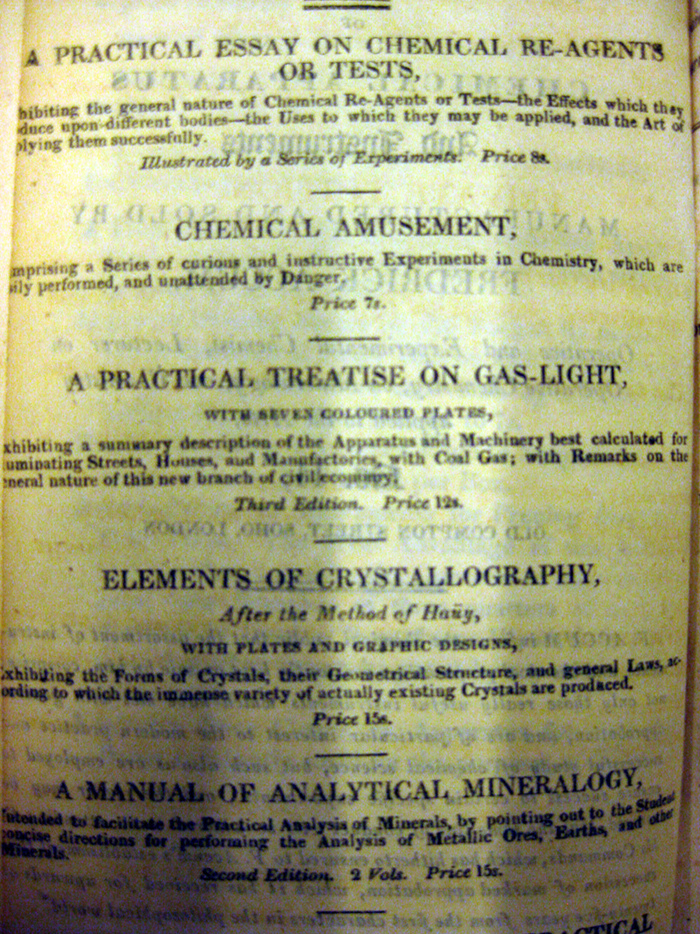
1818: I was fortunate to locate, examine and photograph ephemera at the Boston Public Library.  Although undated, this catalogue offers for sale the first edition of Chemical Amusements (1817) and the Third Edition of Practical Treatise on Gas-Light (c.1816).


The following photographs (mine) therefore illustrate the 1818 prices for "platina" (refined platinum) in various forms.  


F. Accum's 1812, 1816, 1817 and 1818 editions offer identical Platinum prices.  If fine Silver sold at 7s. per Troy ounce in 1812, a Silver Crucible for 18s. was ~15 grams, but the rate for manufactured (imported?) Platinumware is unknown but probably much much greater than wire.  Pt Crucibles were sold in Paris for about £ 0.90 at this time; the manufactured rate in Accum's catalogue follows W. &S. Jones'.

1818: 1 Troy Oz. platina (ore, whols./retail: F. Accum)  = £ 0.25 (USD$ 1.31)
1818: 1 Troy Oz. Platinum (semi-mfg, catalogue) = £ 1.- 1.05 ($5.22 - 5.48)
1818: 1 Troy Oz. Platinum (mfg, catalogue: F. Accum)  ~ £ 1.75 (USD$ 8.05)


1817:


Reference for an uncertain date after 1817 and before 1822:
c.1821?: 1 Troy Ounce Platinum (manufactured, retail) ~ £ 1.05

Citation: Encyclopaedia Britannica: or, A dictionary of arts, sciences, and ..., Volume 2 (1824) p.341


December 1818 - February 1819: £ 1. = Fr 23.40

September 1818:


UK, 1800: Cost of Platina, Platinum


In late 1798, the sudden appearance in London of "a number of bars of platina" suggests a sudden market glut and Platinum price decrease in London, 1799; also, a previously higher price.   Where these bars came from is unspecified - the 4,000 ounces seized in late 1797 ?

Does that notable event help explain why Wollaston's 1805 manufactured price was 75% lower than the import manufactured price cited by Knight in 1800?  (Paris-refined prices may have persisted at higher rates, despite cheaper ore and absent any other 'global' producer competition.)  The wholesale Platinum price was certainly falling, 1798-1805: bars of malleable Platinum came from Paris, presumably.

On 24 December 1800, William Hyde Wollaston and Smithson Tennant entered into financial partnership with a major purchase of 5,959 English Troy Ounces (408.6 English Pounds avoirdupois; 405.28 Spanish libra) of alluvial platina ore at an estimated at 76.27% purity for £795.   See Cambridge University Library Add. MSS 7736, notebook LI. 

It is generally assumed Wollaston's first major platina purchase had been smuggled from Nueva Granada (now, Colombia) to Kingston JAMAICA and thence to London at a wholesale bulk market-price.  But in fact large amounts of seized and auctioned platina, captured from Spanish treasure-ships by British privateers or H.M. vessels almost certainly reached the English market at greatly reduced prices, 1799-1805.  

Wollaston & Tennant's business began merchandising malleable Platinum in 1805. Refined retail Platinum prices in the UK were very stable from 1805-1820, despite fluctuating ore rates.

Wollaston's cost for alluvial ore varied somewhat, and the initial outlay for ore was a relatively low price for his platina purchases, 1800 -1817.  From his Notebooks (recording expenses, commissions, division of profits, income, division of profits, etc.) a great deal may be surmised about the pricing of malleable Platinum:

c.1798: 1 Troy Ounce Platinum (imported French manufacture)  ~ £ 4.26 (USD$ 18.69)

1799-1800: 1 Ozt. Platinum (French ingot, retail) ~ £ 1.864
 
1800: 1 Ozt. platina (Wollaston's initial cost)  = £ 0.1334 (USD$ 0.5853)
1800: 1 Ozt. platina (at purity)  = £ 0.1749 (USD$ 0.7675)

1805-15: 1 Ozt. platina (producer cost)  = £ 0.16 -  0.27 (USD$ 0.63 - 1.25)
1805-15: 1 Ozt. Platinum (refined, whols.)  ~ £ 0.34 (USD$ 1.24 - 1.68)
1805: 1 Ozt. Platinum (refined, retail)  = £ 0.75 - 0.90 (USD$ 3.26 - 3.92)

Citation: Elements of chemistry: comprehending all the most important facts and ... Robert Heron, Antoine-François de Fourcroy (comte), Jean-Antoine-Claude Chaptal (comte de Chanteloup) 1800 p.353

c.1815 history of platina:
Citation: The National register, Vol. 1, Dated 8/3/1816 p.365


1800:  £ 1. = Fr. 24.5238 = S$ 5.0762; 
1800:  S$ 1. = £ 0.1970 = Fr. 4.8311
1800:  Fr. 1= S$ 0.207 = £ 0.0408
 

June 4, 2010

UK, 1842: Grove's Battery

List of Prices of Mathematical, Philosophical, Optical, and Chemical Instruments and Apparatus, Manufactured by Edward M. Clarke (1842?) had identical prices for various equipment with Platinum components as far back as 1835.  

1842:  1 Troy  Ounce Platinum (Semi-Mfg, Retail) = £ 0.75  (USD$ 3.50)
1842:  1 Ozt Platinum (Semi-Mfg, Ret.) = £ 1.50  (USD$ 7.00)
1842:  1 Ozt Chlor-Platinate Salt (PtCl2, Ret.) = £ 0.10 (USD$ 0.47)
1842: 1 Ozt. Irismodine (Ore, Ret.) = £ 0.50 (USD$ 1.75)

Citation: List of prices of mathematical philosophical, optical, and chemical ... ; Edward M. Clarke (1842)


Where Platinum Foreceps cost £ 0.375 (Semi-Mfg Platinum @£ 1.50), the ratio of Retail Manufactures to Semi-Manufactured may be ascertained:  


March 1842:  1 Ozt. Platinum (Semi-Mfg, Ret.) = £ 1.50  (USD$ 7.00)


Where 1 3-Pint Jar contained 103.56 Cubic Inches

Citation: The Mechanic and chemist: a magazine of the arts and sciences (March 1842), p.113


1835: 1 Troy Ounce Platinum (refined)  = £ 1.60 (USD$ 7.76)

Estimating one cell cost £ 0.53, with 2 2" x 4" platinum slips (or 16" sq. of thin slips) per cell. 

1838:


1854: 1 Troy Oz. Platinum (manufactured, retail) = £  1.50 (USD$ 7.32)

Bland & Long's smaller version of Grove's Battery approximates his cost estimate (and size of Platinum foils).  Catalogues likewise show the Foil cost to be the same, in 1835 & 1854.


Where a No.1 cell cost £ 0.50, with one 5" x 3" Platinum Foil (or 15" sq. of thin slips) per cell, etc., each additional sq. inch of Platinum appears to cost £ 0.06, a higher incremental cost.  Estimating 142 sq./oz troy, Platinum for the larger apparatus was double or triple the price per inch and per ounce (by increment) an exceptionally poor deal indeed.  Retail.


Similar batteries wholesaled in NYC in 1856 for $4.50 (rather than £ 2., or USD$ 9.76)  used domestic components.

 
Citation: Descriptive and general catalogue of philosophical apparatus and chemical ... Bland & Long (1854), p.14


Citation: Illustrated descriptive catalogue of optical, mathematical, and ... By Benjamin Pike (1856) p.340


The total Unit Cost of a single Grove's Cell w/ one 6" x 2" foil (24" sq. surface) is £ 0.23, where a single foil cost £ 0.14 (@ £ 0.01125 per sq. in.) or 59% of the Unit Cost.  At a known Platinum price per oz. troy, there might have been 11-12 6"x 2" platinum foils per ounce troy.  Presumably, these are 'smaller' foils (by the sheer number used) - or the Platinum price estimation is off by 50%.


1878/9: 1 Ozt. Platinum (Semi-Mfg, Ret.) = £ 1.60  (USD$ 7.76 - 7.82)

Citation: The British Journal of Photography, (1879), p.137


c. 1878:


1878: 1 Ozt. Platinum (Semi-Mfg, Ret.) > £ 1.50  (USD$ 7.34)

1878:


At a known Platinum price per oz. troy.  There were 6  6"x 3" foils (£ 0.23 each)  or 8 platinum foils per ounce troy.  Presumably, these are medium-sized foils.


 c.1878:  1 Ozt. Platinum (Semi-Mfg,  Ret.) = £ 1.75  (USD$ 8.56)


Citation: English mechanics and the  world of science, Volume 28, 1879, p.419 

Each Platinum Plate/Foil was 9 in² (= 58.064 cm²)


c. 1894 :1 Ozt. Platinum (Refined, Ret.) = £ 2.50 (USD$ 12.15)

With 4 - 5 cells per ounce, the 1854 Grove Batteries (No. 3) were about twice as expensive by unit cost.

Citation: Elementary lessons in magnetism, By William Jerome Harrison (1895) p.37
 

Net the cost of the carbon rod, the other cost of the Element is known.


Electro-plating by Galvanic battery commenced circa 1842 and was patented by J.S. Woolrich of Birmingham.