Where 1 Lb. avd. = 14.583 Ozt., the intrinsic price of Pt was ~$ 8.57/Lb. avd.
1814: 1 Troy Oz. platina (whols., Ore 70%) = USD$ 0.613
1814: 1 Troy Ounce platina (US port: bulk, whols., $6./lb. avd.) = USD$ 0.4114
1814: 1 Troy Oz. Pt (intrinsic @ 70%) = $0.58775
1814: 1 Troy Oz. Platinum (Assumed labor, $6.425./lb avd) ~ $0.44057
At quoted rates, Bollman's Lightning Rod Tips had ~ 12.64 g or 0.40 Troy Ounces of Pt.
1. April, 1814.
Das Marine-Ministerium hat 300 ($ 500 werth) von meinen Platinaspitzen genommen... Ich habe einen Austrag zu $60. per Pfund angenommen. ... Ich bekomme $60 für das, was mich $15 kostet.
The Naval Department has purchased 300 ($ 500 worth) of my Platinum-Lightning Rods)...I have an accepted assignment for $ 60. per pound. ... I get $60 for what cost me $15.
1814: 1 Troy Oz. platina (whols., Ore 70%) = USD$ 0.613
1814: 1 Troy Ounce platina (US port: bulk, whols., $6./lb. avd.) = USD$ 0.4114
1814: 1 Troy Oz. Pt (intrinsic @ 70%) = $0.58775
1814: 1 Troy Oz. Platinum (Assumed labor, $6.425./lb avd) ~ $0.44057
1813: 1 Troy Oz. Platinum (Producer Boiler Price) = $ 4.286
1813: 1 Troy Oz. Platinum (Producer Boiler Cost) = $ 2.857
1813: 1 Troy Oz. Platinum (Producer Boiler Profit) = $ 1.429
1814: 1 Platinum Lightning Rod Tip (Producer Whols.) = $ 1.67/ea.
1814: 1 Troy Oz. Platinum (Producer Cost, $15./lb. avd.) = $1.0286
1814: 1 Troy Oz. Platinum (Manufacturer's Price, $60./lb avd) = $4.115
1814: 1 Troy Oz. Platinum (Mfg's Assumed Profit, $45./lb avd) = $3.0864
At quoted rates, Bollman's Lightning Rod Tips had ~ 12.64 g or 0.40 Troy Ounces of Pt.
1. April, 1814.
Das Marine-Ministerium hat 300 ($ 500 werth) von meinen Platinaspitzen genommen... Ich habe einen Austrag zu $60. per Pfund angenommen. ... Ich bekomme $60 für das, was mich $15 kostet.
The Naval Department has purchased 300 ($ 500 worth) of my Platinum-Lightning Rods)...I have an accepted assignment for $ 60. per pound. ... I get $60 for what cost me $15.
27. April 1814.
Du unterschäzeft die folgen meines Thuns. So unterschäten auch wir Beide eindt bie Quercitronrinde, mit welchem Artikel zwei häuser solide Vermögen erworben haben. Wenn ich einen Lieserungsvertrag zu 40 Pfund abschlieste, so kann ich bequem davon leben. Das ist der ungefähre Verbrauch hier zu Lande, Un Lack werben ungefähr 200 Pfund konsumiert; auch diese kann ich zu demselben günstigen Preise herstellen. Meine Platina-Berkaufe beliefen sich im lechten Jahre auf $ 3000 und seit dem 1. Januar c. auf $1300. Dieser Artikel bietet gleichfalls Ausficht auf einen reichen Gewinn. Das Schlimmste ist, das meine Fabrik viel kostet,
Du unterschäzeft die folgen meines Thuns. So unterschäten auch wir Beide eindt bie Quercitronrinde, mit welchem Artikel zwei häuser solide Vermögen erworben haben. Wenn ich einen Lieserungsvertrag zu 40 Pfund abschlieste, so kann ich bequem davon leben. Das ist der ungefähre Verbrauch hier zu Lande, Un Lack werben ungefähr 200 Pfund konsumiert; auch diese kann ich zu demselben günstigen Preise herstellen. Meine Platina-Berkaufe beliefen sich im lechten Jahre auf $ 3000 und seit dem 1. Januar c. auf $1300. Dieser Artikel bietet gleichfalls Ausficht auf einen reichen Gewinn. Das Schlimmste ist, das meine Fabrik viel kostet,
Chaldecott (PMR 1981, No. 4 pp.162-73) cites an 1814 letter* from Erich Bollman to then Secretary of State James Madison.
Elsewhere mentioned, the c. 1813 price of platina was $5./pound avd in Jamaica and $6./pound avd. in Philadelphia. From Chaldecott (PMR 1983, Vol. 27, No. 2, p.81):
"[In August 1814, Bollman] told Wollaston that supplies of crude platinum could be obtained from the merchant firm Adams, Robertson & Co. of Kingston, Jamaica, and that smuggled ore could not be bought at Cartagena for less than five Spanish dollars a pound (avoirdupois?) equivalent to 1s. 6d. an ounce troy, and that the price at Philadelphia was six dollars (6)."
Dr. Erick Bollman's Platinum-work was a short-lived venture, but marked the first native Platinum production on record in the USA. In letters to his brother, Bollman indicates prices (avoirdupoids) for platina & Platinum. The major project appears to be the 25-gallon sulphuric acid still, ~700 Troy Ounces @ USD$ 3,000. for John Harrison.
If refined 700 ozt (at 70% ore purity) is assumed correctly, the Harrison project required almost exactly 29 kilograms (64 lbs avd.) of raw platina. That large bulk price actually seems high for the period, given the world market (platina glut) but there's no US data to assume the Philadelphia price was ever lower.
The Boiler cost Bolllman more than $2,000 to manufacture ($384. in platina), with $1,616 in various expenses (laborers, etc.), resulting in <$1,000. profit.
Unfortunately, Bollman underestimated costs and didn't understand the Platinum market. But he remained a Platinum bug until the end, dying in Jamaica on return from an investigatory expedition on behalf of Barings Brothers to the the 'only source' known; Choco, Nuevo Grenada.
On the US Eastern Seaboard, platina was about half- to one-third the London price.
1814: 1 Troy Oz. Platinum (intrinsic, refined, bulk) = $3.00
1814: 1 Troy Oz. platina (Jamaica: bulk, whols., ore) = $0.338
1814: 1 Troy Oz. platina (US port: bulk, whols., ore) = $0.4114
1814-6: 1 Troy Ounce platina (London: whols., ore) = $0.64 - 0.98
*US. National Archives Building, General Records of the Department of State, Record Group 59, Microcopy M-179, roll 29: letter from E. Bollmann to the Secretary of State dated 16 March I 814. For text of letter see F. Redlich,“Eric Bollmann and Studies in Banking”, New York 1944 pp.84-85
1814: Bollman's entreaty to sell his Platinum to the Commonwealth of Pennsylvania.
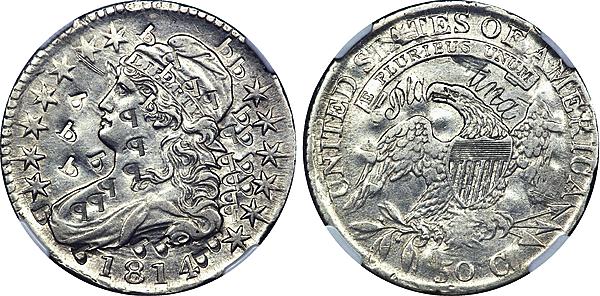
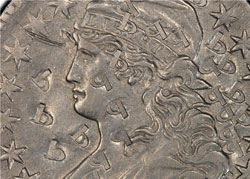
The US Mint held on one of Bollman's Coin Pattern in the early part of the 20th C. The Platinum was likely accumulated residuum from the Philadelphia Mint's Gold refining operations, after treating ore from Chocó.
At no additional cost (but for loss paid on 'Gold' ore) the Mint did not knowingly nor intentionally purchase additional platina ore: Pt cost was therefore essentially nil.
The intrinsic value of 0.7181 Troy Ounce Fine Pt @ "USD$ 3./oz" in 1813/4, the intrinsic value this coin would be $2.1544. By the Specific Gravity, however, the Coin appears to be 5% Ag, therefore worth ($2.05 + $0.05) $2.10 at presumed market prices for PMs.
Weight: 344.7 Grains Troy
Specific gravity: 20.9 (95% Pt, 5% Ag)
Diameter: 32.6 mm.
This coin was acquired by Charles Link in August 2011 and certified in 2012:
http://www.pcgs.com/News/PCGS-Certifies-1814-Platinum-Half-Dollar
http://rob.com/russ/collection/2316.html

1758: Reportedly, the Platinum-tipped Lightning Rod was Benjamin Franklin's invention.
Description of a Platina Point:
1814: Accum's Chemistry and Bollman's Platinum in the textbook.
Citation: System of Theoretical and Practical Chemistry; Friedrich Christian Accum, Thomas Cooper (1814)