Showing posts with label Assay. Show all posts

June 7, 2013

Russia, 1827

As Kancrin estimates, if the Russian Government paid 5,790.72 руб Acc. per Poud, the SPb Mint price for ore at .70 Fine Pt was 353.51 руб Acc./Kg (= £ 14.73; Fr 377.36; USD$ 72.85-73.42) with no tax/levy factored.

If the Mint cost, as noted, was 6,714.24 руб Acc. per Poud, the SPb Mint the first base cost for 'pure' Pt was 409.89 руб Acc./Kg (= £ 17.08; Fr 437.55; ~USD$ 84.47-85.13).

Kancrin also estimated the London Price of Platinum @ 771.62 руб Acc./Kg (£ 32.15)
 
If the Russian Government paid 2,300 руб Acc. per Poud, Kancrin's estimate was wildly mistaken; instead, it appears the 20th C. observers have misstated and miscalculated the contemporary Banco/Silver Rouble rates.   

From Kancrin's cost estimate for 70% ore, delivered at SPb: 1,372.57 руб Ag, or 83.79 руб Ag/Kg.; and for refined 1,591.47 руб Ag, or 97.16 руб Ag/Kg.

By the Russian Poud, 1 Kg. Platinum at the SPb Mint was sold @ 1,172.13 руб Kr in 1827.
.... 1 Kg SPb Platinum (8/1827) = £ 48.84;  Fr 1,251.20 ; ~USD$ 241.55 - 243.44
 

c.1827: 1 Troy Ounce platina (SPb)= 4.3673 руб Acc. (1.1704 руб Ag)

Citation: Transactions of the Institution of Mining and Metallurgy, Vol. 21 (1912) p.650


c.1827-1832: 1 Troy Oz. Platinum (SPb)= 34.18 руб Acc. (9.18 руб Ag)


Qiring's estimate errs in calculating the Silver Rouble rate.

Citation: Die metallischen rohstoffe, ihre lagerungsverhältniss und ihre wirtschaftliche bedeutung..., Vol. 16 (1962) Heinrich Quiring
 
"1826/27 wurde in St. Petersburg Rohplatin mit 171.5 Rubel, reinplatin mit 283 Rubel je kg. bewertet." 

 
Citation: Bulletin universal des sciences et de líndustrie..., Vol. 9 (1828) p.3

 
July, 1827:
7/27: 1 Troy Ounce platina (SPb: 71.37% pure) ~ 15.61 руб Acc. ~ 4.19 руб (Ag)
  
7/27: 1 Troy Ounce platina (SPb)= 21.87664 руб Acc. ~ 5.873 руб (Ag)
7/27: 1 Troy Oz. Pt (SPb: refining 'cost') ~ 7.292 руб Acc. ~ 1.9575 руб (Ag)
7/27: 1 Troy Oz. Pt (SPb: refining price) ~ 11.303 руб Acc. ~ 3.0342 руб (Ag)
7/1827: 1 Troy Oz. Pt (SPb, sponge) = 29.16885 руб Acc. ~ 7.83 руб (Ag)
7/1827: 1 Troy Oz. Pt (SPb: semi-mfg) = 36.46107 руб Acc. ~ 9.7875 руб (Ag)


July, 1827: 1 Troy Oz. Platinum (Paris retail) = 32.16 руб Acc. ~ 8.633 руб (Ag)

From von Humboldt's data, Count Kankrin estimated the average Chocó platinum yield to be  20,012.5 ozt (~622.5 kgs.) Kankrin also estimated the platina purity at 71.36735%, so  

1827: 1 Troy Oz. Platinum (Cost Basis) = 17.866 руб Acc. ~4.796 руб (Ag)

He estimated the Platinum value at 4.41 руб Banco per Solotnik (equivalent to the Paris Price) so: 


1827: 1 Troy Oz. Platinum (cited UK Price) = 24. руб Acc. ~6.44 руб (Ag)   
1827: 1 Troy Oz. Platinum (Cancrin's est.) = 32.16 руб Acc. ~ 8.633 руб (Ag)   
1827: 1 Troy Oz. platina (miner cost, at purity) = 11 руб Acc. ~ 2.95 руб (Ag)  
1827: 1 Troy Oz. Pt (refiner cost) = 1.75 руб Acc. ~ 0.47 руб (Ag)  
1827: 1 Troy Oz. Platinum (First Base Cost) = 12.75 руб Acc. ~ 3.423 руб (Ag)

1827: Miner Cost (Russia)  = £ 0.4584 ; Fr 11.74  
1827: Refiner Cost (Russia) =  £ 0.0731 ; Fr 1.872  
1827: First Base Cost (Russia) =  £ 0.5315 ; Fr 13.612  
1827: 1 Troy Oz. platina (SPb: 80% pure) = £ 0.73 ; Fr 18.70 
1827: 1 Troy Oz. platina (SPb: at purity) = £ 0.9115 ; Fr 23.34  
1827: 1 Troy Oz. Pt (SPb, sponge) = £ 1.215 ; Fr 31.12
1827: 1 Troy Oz. Pt (SPb, semi-mfg) = £ 1.519 ; Fr 38.90 

"It is not likely that the expected global supply of Platinum will even increase much, because after your own estimation of the gold-yield from Choco is 10,800 marks, assuming a full third of which is Platina, will come out to about 3,000 marks, or nearly 38 pouds."

Citation: Im Ural und Altai: Briefwechsel zwischen Alexander von Humboldt und Graf ...Alexander von Humboldt, Egor F. Kankrin


"In any case, it's unlikely to suddenly happen that the collapsing value of platina and Münzemanation (coin debasement?) can be circumstantially foreseen. Therefore, I believe that no interfering coin confusion could arise."


"How have I valued the coin? Platina to silver is calculated at '5 to 1.'  The value of legal Rouble-weight in Platinum would be 5.7526 Roubles (this deviates from the calculations of the last letter somewhat) and with seigniorage of approximately 24 Kopecks per Six Silver Roubles; half Rouble-weight so 3 Roubles, and this should be the smallest coin struck.  Platinum would then be worth to 4.41 руб Banco per Zolotnik, and therefore isn't excessively profitable over the mining cost.

In the case that the proportion of 5 to 1 would be too high, I would have suggested of 4.25, where the weight Platinum would make 5 Roubles silver, but that would puts Zolotnik at 3.75 Roubles Banco. This coin is not as uncomfortable as it was only the size of half a Rouble; beat to a 2.5, but it would not quite fit.

If both ratios to be high, it might be to go even safer, the Rouble weight Platina to 4 and take half to 2 Roubles silver coin. This would be the proportion of 3.25 to 1, the value of 3.74 rubles weight fraudulent rubles silver coin and a seigniorage of 26 Kopecks, 4 rubles, ie 2 half rubles, a very suitable coin.  In paper this would be 2.865 руб Banco per Solotnik, which still came out a little advantage, or no one would give his Platina to be coined. You can broadly estimate production of 10 Solotniks raw Platina costs 15.08 руб Banco.  The cleaning cost is about 2.405 руб Banco, 17.485 руб Banco in total.  The pure Platinum obtained will be 7  Solotniks, so pure Platinum comes to 2.495 руб Banco per Solotnik.   Against the 3.25:1 ratio, the profit, except for Seigniorage, is therefore only 0.37 руб Banco.

However, contrary to this insignificant profit trade prices. After just received news from London Platina troy ounce can be sold in bars for twenty shillings, which account for about 24 rubles paper. After that, the Solotnik such Platina would come to 3.29 Rubles paper. The value of silver is o.23703 руб Banco per Solotnik, so the relation of Platina to silver would be in this case as 3.73:1. It follows that the proportion of 3.25:1 is too low."


1827 Platina Yield (at Mint Price, Retail)
13,561 Ozt :  296,638 руб Acc. = 79,499 - 79,849 руб Ag 

.... @ £ 0.1542 руб Ag: £ 12,256 - 12,310 ; @ £ 0.0427 руб Acc. : £ 12,669

1827: 1 Troy Oz. platina  = £ 0.9038 - £ 0.9342

Citation: Narrative of a Visit to the Courts of Russia and Sweden: In the Year 1830 & 1831, Vol. 2;  Charles Colville Frankland (1832)


Citation: St. Petersburgh, a journal of travels to and from that capital, Vol. 2;  Augustus Bozzi Granville (1828) p.158


'Common platina' bluish tint: Specific Gravity of 17. - 17.61 = ~72% Pt

Better quality nuggets (Specific Gravity of 19.17) were 80.9% Pt, 11.07% Rh, 1.64% Pd  


No. 1:  A Platinum Pattern-piece, struck on the Rouble Die (1827?)
Weight: 8 Sol. 42 Th. (35.99 g. = 1.572 Ozt) -- The Onza was 28.76g. ; 0.92466 Ozt)

No. 8: The largest Coronation Medal.  

Perhaps Bonham's 8 Dec 2010, Auction 18404 Lot 1034: a Coronation Medal weighing 15.6 g sold for USD$ 12,870 (incl premium) 1,388.4% over Spot.
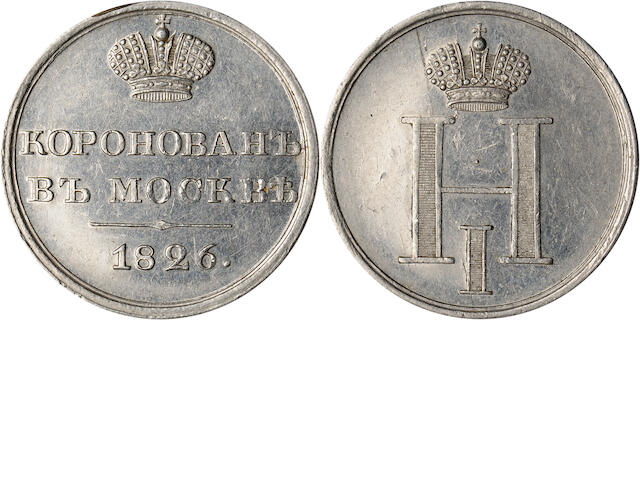
https://images2.bonhams.com/image?src=Images/live/2010-08/09/8133435-3-2.jpg&width=640&height=480&halign=l0&valign=t0&autosizefit=0 Citation: Im Ural und Altai Alexander von Humboldt (1869) p.5


Found in 1827, reported in Europe February 1828.

1836: Russian 10.5625 Funt = 4.326 Kgs (9.536 Lbs avd.) ~66% Pt, ~68% PGMs


June 1827: The largest platina mass then found, 4.33 kgs (~12 English Troy Pounds, 139 Ozt)


Largest Nugget 'yet discovered' in June 1827, reported in St. Petersburg August 1827 (+1.5 months), Southern Germany (+2 months), in London October 1827 (+3.5 months), on the Eastern seaboard USA by January 1828 - a delay of +7 months.  

The 1827 Nugget weighed 10.5625 фунт (139.067 Ozt; 4.3255 Kgs) at 50% Pt


Still described & reported by travelers as "the largest nugget," as late as 1835 (1838)


Außerordentliche Beilage zur Allgemeinen Zeitung 1827. Nr. 43. (12/8/1827)
Von den in Sibirien aufgefundenen gediegenen Platina-Massen.

Extra Supplement to the Allgemeine Zeitung in 1827. No. 43  (12/8/1827)
On the discovery in Siberia of solid platina nuggets.


1827 Platinum Yield of Urals, as reported in 1829: 
13,557 Ozt. = 25.74 Pouds

1827: 1 Troy Oz. Platinum (SPb) ~ руб Acc 9.85 - 10.09 (£ 0.420447)


1827: 16.564 Pouds ~8,723 Oz, ~ 271.33 Kgs.

Citation: The Encyclopaedia Britannica: Or, Dictionary of Arts..., Vol. 7; Vol. 15 (1842) p.254


Purity of Ural platina


1827: Purity of platina sold at SPb Mint: 81%


October 13, 2012

US Platina, By Purity

US platina

Citation: U.S. Geological Survey professional paper


California, c. 1900


Citation: U.S. Geological Survey


Oregon

November 1, 2011

Russia, 1835: Iridium

In 1835, Davy's Catalogue retailed Iridium for 22.5x the Platinum price.  

1835:  1 Troy Ounce Iridium (UK: refined, retail) = руб Banco 881.3
1835: 1 Troy Oz. Iridium (UK: ore, retail) = руб Banco 180.3  
1835: 1 Troy Oz. Platinum-Black (UK: hypothetical, retail) ~ руб Banco 135.22 (£ 6.0)


1835:  1 Troy Oz. Iridium (London Retail: ore) ~ руб Banco 192.0
1835:  1 Troy Oz. of Platinum (USA: semi-mfg, sheet, mkt.) ~ USD$ 7.50
  

1831: 1 Troy Oz. Platinum-Black (Germany: trade) ~ руб Acc. 21.13

 
1834: 1 Troy Ounce Iridium (StPb price) = руб Banco 43.75 (Fr 39.02)
.... (£ 1.941; USD$ 8.76) 


1834: 1 Troy Oz. Platinum-Black (SPb: residue) = руб Banco 7.29 
.... (Fr 6.502; £ 0.323; USD$ 1.46)

In 1845, Menier's Catalogue retailed Iridium for 4.62x the Platinum price.  At retail, refined Iridium was 4.5x the ore price. Platinum-Black was 50% higher than Platinum.

In 1855, Chilton's Catalogue retailed Iridium for 4.47x the Platinum price. (Imported?) Platinum-Black was 100% higher than Platinum, however.
 
1825?: 1 Troy Oz. Platinum (Paris, hypothetical retail) = Fr 94.12  

1825?: 1 Troy Oz. Iridium (Paris, retail)= Fr 487.55 (~руб Banco 434.85)


Hypothetically, the lowest SPb wholesale bulk values local merchants paid for Platinum calculate accordingly.  This does not mean foreign merchants exported at such low rates, however.

Wholesale Platinum in Paris was only ~2x higher than the St. Petersburg scrap rate.
The US Market Price for scrap Pt was ~4.5x higher than the St. Petersburg Price.

1834: 1 Troy Oz. Platinum (StPb whols) > руб Banco 8.19 (USD$ 1.70)
1834: 1 Troy Oz. platina (78.94% StPb whols) ~ руб Banco 5.75 (USD$ 1.19)

1831: 1 Troy Oz Pt (Coined) = 11.03 руб Silver = 40.44 руб Banco

1834: 1 Troy Oz. Platinum (@ 2.5 руб Ag =3 руб Pt) ~ руб Banco 27.17 (USD$ 5.63)
1834: 1 Troy Oz. Platinum (coin, at mkt) ~ руб Banco 25.95 (USD$ 5.38)


Die Entdeckung des Platina im Ural seit dem jahr 1824 und die spätere bedeutende Gewinnung derselben bewogen die Regierung dieser Metall reinigen zu lassen und in Geldmünze zu verwandeln. Die zu diesem Behuf im jahr 1828 im Laboratorium des Departements des Bergwesens und der Salinen vollzogen, nach der Methode des Obersten Sobolewski, getroffenen Einrichtungen reinigen das aus sämtlichen Kron- und Privatbergwerken gewonnene Platina;  das auf diese Art gereinigte Platina wird dem St Petersburger Münzhofe übergeben und zu Münze an Werth von 3, 6 und 12 Rubel Silber geprägt. Zur Verfügung des Laboratoriums verbleiben bei der Reinigung des rohen Platinas einige unauflösbare Thiele die aus einer Verbindung verschiedener Metalle bestehen und woraus das Irid gewonnen wird. Das nach Paris gestande Irid erregte bei französischen Gelehrten und Künstlern Bewunderung, und in Paris bezahlte man anfänglich für die Drachme Iridium 60 Fr. Der hohe Preis mehr aber noch die Seltenheit des Iridium waren bis jetzt einzig und allein daran Schuld, daß dieses nützliche Metall nur wenig im Gebrauche zu finden war. Der Kaiserliche Finanzminister Graf Kankrin, hat nun verordnet, das Laboratorium angehäufte Iridium und die bei der Reinigung des Platina gewonnenen unaufgelösten Theile zu mäßigen Preisen in den Handel zu bringen. Demzufolge soll der Solotnik Iridium hier zu 6 Rubel die unaufgelösten Platinatheile aber zu 1 Rubel Bco Ass. verkauft werden. Diejenigen welche diese Gegenstände zu kaufen wünschen haben sich an den Obersten Sobolewski zu wenden.  

The discovery of Platina in the Urals since the year 1824 and subsequent significant recovery of the same induced the government to clean the metal and turn it into coin.  The Laboratory of the Departments of Mining and Salt Industry was fully attracted to this purpose in 1828, adopted as a refinery to make ​​the Platinum obtained from all Crown- and private mines following the method of Colonel Sobolewski; in this way, purified Platina is sent to the St. Petersburg Mint and coined to the value of 3, 6 and 12 Rubles Silver.
Available from the Laboratory, remaining from the purification of the crude platina, in some indissoluble parts which consists of a combination of different metals and from which Iridium is obtained. To this last others confess excitement, among French scholars and artists admiration, for in Paris they initially paid for Iridium Fr 60. per drachme (= 3.83 Gr; 0.897 Zolotnik) The high price but still more the rarity of Iridium were until now solely to blame, that this useful metal was barely employed.  The Imperial Finance Minister Count Kankrin has now ordered the Laboratory to bring  instructions for refining  Platina-Black and accumulated Iridium to the market at reasonable prices. Consequently, the Zolotnik Iridium here costs 6 Roubles, the undissolved Platina-Black sold at just 1 Rouble Banco Assignati.  Those who have want to purchase these items to appeal to the Colonel Sobolewski.

Citation: Oesterreichischer Beobachter (April 1836) p.603

Citation: Augsburger Postzeitung (May 1836) p.603

Iridosmine assay:


1834: The Platinum Rouble was discounted against Silver

Citation: The merchant's assistant, or, Merchantile instructer; Georg Thomas Flügel, Francis Joseph Grund (1834) pp.

Russia: As "Gold was considered 5x more valuable than Platinum" the value of the Platinum Rouble might otherwise be valued as low as $ 0.145 - 0.16 per Rouble, in scrap. (This statement conforms with the rate indicated as Buyer's Scrap, above.)

Essentially, intrinsic Platinum Coin fell to the rate of Banco Roubles - perhaps lower at times.

Citation: Dictionnaire du commerce et des marchandises, contenant tout ce ..., Vol. 2 (p.

1835: Less informed Americans reported the platinum coin was more valuable than the market-price, deceived by earlier statements. 


Circa 1834/5:
 

1 руб Banco = Fr 1.093;

Monnaies. La monnaie de compte de toute la Russie est le rouble, subdivisé en 100 kopek. Mais la valeur numéraire de cet empire ne consiste qu'en papier-monnaie, appelé: Assignation de banque. Les coupures de 200, de 50 et de 25 roubles, sont sur papier blanc; celles de 10 roubles, sur papier rouge, et celles de 5 roubles, sur papier bleu ; leur valeur représentative est la monnaie de cuivre, contre laquelle elles sont échangées par les banques établies dans les grandes villes. La valeur intrinsèque de ce rouble-papier, comparativement au rouble effectif en argeut, est de 200,264 roubles papier, pour 1 kilogramme en argent fin, ou 109,3 centimes pour un rouble papier. Nous justifierons cette assertion par le système monétaire des monnaies effectives nationales en circulation.

Celles en or, sont;
Le ducat, en tout conforme au système monétaire de la Hollande et de l'Allemagne, de la valeur numéraire de 3 roubles, équivalant à Fr 11, 89 cent. Les Hotels des monnaies n'en émettent plus, et depuis 1817, on ne fabrique plus que des impériales, à 10 roubles, et des demi-impériales, a 5 roubles, au titre de 86 solotnik (0,916 2/3) et a la taille de 34 2/13, et 68 4/15; leur intrinsèque est par conséquent de 417,2167 et de 834,4334 pour un kilog. en or fin, ou de Fr 41 26 cent., et Fr 30 58 cent. la piece.

En argent:
Le rouble simple, le demi et le quart, suivant on ukase du 20 Juin 1810, vieux style, au titre de 83 1/3 solotnik (0,868 et ont petite fraction), et a la taille de 19 61/81 ; leur valeur intrinsèque est par conséquent de 55,629 pour un kilog. en argent fin, ou 3 Fr 83 1/2 cent.

En cuivre:

Des pièces de 2, 1 et 1/2 kopek, en raison de 96 roubles d'an pud equivalent a 16,3624 kilog., ce qui fait ressortir le kilog. de cuivre a 8 fr. 66(?) cent. Cette valeur exorbitante est la cause naturelle de la dépréciation du papier monnaie, qui ne peut s'échanger an pair que contre du cuivre et contre des monnaies d'or et d'argent à des prix variable, qui coutent ordinairement de 380 a 390 kopek papier, pour 1 rouble en or, et de 360 a 370 kopek papier, pour 1 rouble en argent. Une ordonnance du gouvernement de (l'astrube?) 1832 a fixé cet cours, pour les droits de douane, a 380 du rouble en or, et à 360 du rouble en argent.

Par un ukase du 6 mai 1828 vieux style, les propriétaires des mines de platine de l'Ural, Demidow et Jakolew, ont été autorisés a faire fabriquer des monnaies de ce métal, du poids de 2 41/90 solotnik, 9.928 grammes pur et sans aucun alliage, et de les émettre pour la valeur numéraire de 3 roubles en argent; plue tard , le 12 octobre 1829, cette autorisation a été étendue a des pièces d'un poids double et quadruple, dont la valeur numéraire a fixee en proportion, c'est-a-dire a 6 et 12 roubles en argent. Cette monnaie est maintenant très répandue dans la circulation; elle est même préferee aux anciens ducats en or par les marchands des provinces de l'interieur, surtout par les paysans, qui leur ont donné la nom Strelkï (des Petits Gris): il y a cependant à faite observer que la valeur numéraire de ces pièces n'eu aucunement eu rapport avec la valeur vénales de ce métal, car en determinant le prix de kilog. suivant la valeur intrinsèque de 3 roubles en argent, il ressort a Fr 1,141.43 cent., ou a peu près au tiers du prix de l'or, tandis que ce dernier vaut environ cinq fois plus que le platine.

Les monnaies étrangeres ont été tarifiées par une ordonnance de ministère des finances, du mois de septembre 1834.

This currency is now quite widespread in circulation;  it is even preferred to the former gold ducats by merchants in the interior provinces, especially the peasants, who gave them the name Strelkï (Little Grey Ones) : however, it was observed that the cash value of these coins had had no connection with the market value of the metal, because by determining the price of 1 Kg and following the intrinsic value of 3 Silver Rubles, it's evidently Fr 1,141.43, or about a third of the price of Gold , while the latter is about five times Platinum.

Paris Market, circa 1832?

1835: 4,622.9 Funt = 60,865.6 Ozt.


c.1835: