Showing posts with label counterfeit. Show all posts

July 17, 2015

Switzerland, 1897

If the republished article was correct with the Swiss Scrap rate, the metal merchants offered (Bid) only 50% of the US/global market rate.

1897: 1 Ozt. Platinum (Paris: Ingot, Mkt) = Fr 62.21 (USD$ 12.16) 

Mid-1897?: 1 Troy Oz. Platinum (Semi-Mfg, Retail) = USD$ 15.55
 
Apparently, Scrap Bid was half-retail.  To dealers, the counterfeit FFr 20 (assumed 6.45 g.) was worth SFr 8. (USD$ 1.542), or about USD$ 7.75.

1897: 1 Ozt. Platinum (Geneve: Scrap Bid, Mkt) = Fr 38.60 (USD$ 7.45)


1897: 1 Ozt. Platinum (Geneve: Scrap Bid, Mkt) = Fr 38.57 (USD$ 7.96)

Where a true mint state FFr 20. (Napoleon III, 1866A and anchor : cf. Fr.584; cf. KM.801.1) should weigh 6.451 g, a true example worn to this grade might weigh 6.43 g.  This slightly crude counterfeit in Platinum weighs 6.69 g, implying the uncirculated counterfeit originally weighed 6.80 g., 3.97% overweight.


See France, 1890.

c.1893 the French press reported that each spurious Fr 20 netted the counterfeiter Fr. 6; however, the coins had been produced in the 1860-70s yet the total 'first cost' (tools, materials, labor AND secondary/tertiary expenses of the criminal enterprise) is unknown, assumed to be Fr 14.

"Ces pièces reviendraient à 6 francs chacune aux faux monnayeurs qui les mettent en circulation." 
 
Scrap metal dealers reportedly paid Fr. 8 for 6.45 g;

Counterfeit Fr. 20 coins, first.  Most common are gold-plated Platinum; they are very well-struck; they have the legal weight to about two milligrams; it is not by weighing one can distinguish them. There are even some in the gold {treasury} of the Banque de France. They show the portrait of Napoleon III, various years, uncrowned before 1860, crowned from 1860 to 1870. There are also, but in smaller numbers, with the effigy of the Republic, the years 1873, 1874, 1875 and 1876. 

Here what signs we can ensure that they are false:

Uncrowned Coins. - The sound resembles Silver, clearer and brighter than true coin. On the edge, the words "Dieu protège la France" are almost illegible; the characters are hackly.  The {Obverse} effigy lacks relief; the hair-parting forms an overly accentuated bar, the face is too full, the ear too crushed, the goatee raised in point instead of falling right.  The letters of the epigraph are smaller.  On the Reverse, the characters "20 FR" are too big and weapons are too flat.

Crowned Coins. - The Emperor's head is shorter; the laurels are thicker. Same defects as the former.

Coins of the Republic. - On the Obverse, right leg of the Génie seems broken and presents a slight break in continuity.

We must keep close watch on the whole to collect all these irregularities. The weak point of this counterfeit lies entirely in the gold plate cladding the Platinum. This layer wears off from the first friction and shows the white color of the Platinum on the high points of the edge. The edge - so that's what must be examined - and the letters of the edge. These Platinum counterfeit Fr. 20 coins are, of course, cut at the counters of large administrations. Metal dealers then buy them for Frcs 8.  There are also Fr 20 coins with a copper core but so well imitated that one cannot recognize them at first sight. It is their weight that betrays them: they are a third lighter than those that are good; finally, they have a strange sound.  As for the counterfeit  Fr. 10 coins, they have the same features as those of Fr. 20. But they are far less numerous, because their first-cost does not leave sufficient profit - and the risks are the same.

Citation: Revue suisse de numismatique, Vol. 7 (1898) p.417

February 5, 2015

France, Platinum Louis d'Or: 1801 - 183?


The Double Louis officially weighed 15.297 g. (236 English Grains Troy, 1.376 m.) @.900 Fine, 212.46 grains Fine Gold.

Citation: Traité des monnaies d'or et d'argent qui circulent chez les différents peuples...; Pierre-Frédéric Bonneville


c.1829:

c.1844: 236 grains =15.293 g.; 212.3 grains = 13.757 g. Fine Gold

Citation: Bankers' Magazine, Journal of the Money Market..., Vol. 1-2 (1845)


c.1834: Actual Circulated Coin 232 grains =15.03 g.; ~209 grains = 13.528 g. Fine Gold

In ~45 years, the standard Double Louis in circulation lost 4.1 grains.


Although finer examples weigh 15.29, this Double-Louis dated 1786 reportedly weighed 15.31 g. (236.27 grains), showing wear. 


Platinum Counterfeit, without gilding: stated as 15.13 g. (0.48644 Ozt) Diameter: 28.5 mm


Counterfeit Double Louis Gold Coins (c. "1787"):
{After December 1801} To start a new job, {Louis} Sénot bought {Francois}Roy two lots or forty-two marcs platina ore, which he gave to {Pierre-Joseph} Brasseur. At the latter's abode, they formed planchets, which were struck at Passy, and produced 350 Double Louis.  In March thru June 1802, {Aubin} Quartier sold them to Vigie,who passed on to Dumont and Poulareau.

Citation: Recueil des causes célèbres, et des arrêts qui les ont décidées, Vol. 4, Door Maurice Méjan


Where the Paris Marc (0.24475 Kg) = 7.86889533 Ozt., 42 Marcs = 10.28 Kg or ~330.5 Ozt.
Assuming Abraham L. Breuget purchased and re-sold better quality platina, 75% Pt purity, 42 Marcs should have produced ~248 Ozt Fine Pt. ; 80% Pt produced ~278 Ozt.

In Gold-alloy, 350 Double-Louis weighed true at ~172.1 Ozt, with 155. Ozt Fine Au.  However, 1801 manufactured counterfeits of 14+ year old (1788) coins should have appeared neither suspiciously new nor full weight; average weight for 350 1788 Double Louis might be 170.64 Ozt, ~153.6 Ozt. 


The first stage of the operation (refining) appears grossly inefficient, unless the platina was of exceedingly very poor grade (~47% Pt.) Alternately, ~60 - 76 Ozt otherwise remained or 'disappeared' (sold as scrap to market, unaccounted for in the criminal report.) Another theory makes sense: Sénot agreed to refine the platina for Breuget, providing the Paris watch-maker with about half the Fine Platinum (~143 Ozt, or 9 Livres) at no cost a month or so later. 

The coins were discounted at least 10.42% below nominal value and perhaps significantly below market value for true Double-Louis at the time. 

Unknown, the cost of the platina and the expense for the manufacture of blanks would establish the profitability of the enterprise.

If 330.5 Ozt platina ~ 155 Ozt = Fr. 15,050 - 16,800,


By reasonable timeline, 

In 5-6 months, three counterfeiters refined and produced 350 Platinum-Gold coins. 
1 coin per day? 


Paris Counterfeiters purchase massive quantities: ~2,408 Ozt total: at 70% Pt ~ 1,685 Ozt. 

QUARTIER purchased an additional 300 Marcs from England, plus 6 Marcs from Janetty (late 1802?) at unknown price.

p.355


282 Single Louis d'or = ~62.44 Ozt Pt


"These pieces are made of platinum covered with gold, of which they contain three francs worth at the very best." 

Fine Gold = 0.86 g., 13.3 Grains


1801: 1 Troy Ounce Platinum (Coined, Counterfeit Fr.) = Fr. 97.084 - 108.3725

Les premiers faux double Louis de 48 livres en platine doré seront découverts dans un atelier clandestin de la Creuse fin 1804. Pourtant, un autre rapport du 4 avril 1805, indique que les premières fausses monnaies en platine semblent être des Louis de 24 livres, fabriqués par un certain Miot et par un Orfèvre de Troyes nommé Guérin. (?)

The first dual fake Louis 48 pounds in gold plate will be discovered in a sweatshop Creuse end of 1804. Yet another report of April 4, 1805, indicates that the first fake currencies platinum seem to be Louis 24 books, produced by a Miot and a goldsmith named Troyes Guerin. (?)  

See also:
Numismatique & Change, "Mystère autour du faux double louis en platine 1787 BB" : 65 (43), 70 (24). 


Platine. 15,11 g. 28,5 mm.

This copy is a fake Double Louis in gilded platinum, see note 117) F. Droulers in his Encyclopédie, tome III, p.149 and an article of the same Numismatique et Change in October 2000 that indicate these Double Louis would have been made during the Restoration. The same author had already studied these fake Louis in platinum from Strasbourg and Orleans in Numismatique et Change of July 1978 et dans le BSFN of January 1979. Technically, the striking of counterfeits could only have  occurred only from the Empire Period. Errors are detected, the date in 1787 when Strasbourg was closed; as for Orléans the workshop was not allowed to strike gold and the different use on counterfeits only appeared in 1788. This beautiful specimen is struck with edges made very property. Even wear indicates average circulation. Interesting example. 


1009. ROYALE FRANCE , Louis XVI (1774-1793), Double Louis d'or with bare head, BB 1787, Strasbourg. Contemporary counterfeit in gilded Platinum. Right: Bare head left, long hair. Different: heart (Jean-Louis Beyerle). Reverse: Multiple ecus of France and Navarre under a crown. Different: Toothed Edge (John Guerin). Ref .: Dupl 1706 var.; Ci, 2182 var.; Gad. 363; Dr., 614 (listed only 6 copies). 15,27 g. Extremely Rare. Flawed planchet and the assayer's test on the edge.

Counterfeit Double Louis "1788" (but produced at an unknown date):

Where the 1785-91 Double Louis weighed 15.2970 Grams with a Specific Gravity ~18.7, the False Double Louis should have had a Specific Gravity of ~15.35. 

The False Double Louis had ~ 4 Grams .999 Au and 11.2 Grams .98 Pt. Silver was presumably some part of the solder, an unknown alloy. Aqua regia would rapidly dissolve Copper and and because the dissolution had a greenish tint, Copper was quite possibly omitted from the analysis, in error.

Factoring alloy-solder (90% Au, 8.34% Cu, 16.67% Ag) with Fine Gold, it seems about 1.5 grains Troy were lost and the full solder weight should have been 1.21 Grams: about 7.8% of the circulated counterfeit's absolute weight. Deducting also the Platinum planchet (11.2 g), the Fine Gold gilding (shell) then appears to have been 3 g.

Two problems arise: what was the presumed loss of Copper, and what was the 'wear rate' (to calculate the original total weight) ?


Assuming the Double Louis should weigh 15.297 at full Mint weight new, and a constant wear-rate, the ordinary Double Louis in 1835 weighing 15.25 g had lost 1.5 mg or ~0.02315 Grain Troy per 5 years.  Assuming the rarity of an intact counterfeit implied a circulation rate half the norm, full weight of the counterfeit may have been as high as 15.471 g.

Given the gilding weight remaining, the intact shell should have weighed 3.3%, in the correct alloy proportion with French coin in 1788. (Copper Loss: 0.3 g.)  

The coin was 0.13 cm thick and the circumference was 7.288 cm, so the 'area of the circumference' (approximate value of the edge) was 0.94744 cm2.  The diameter was unstated but correct at 23.2 mm, so the area was 5.3824 cm2 per face.  The entire surface should have 11.715 cm2 of Fine Gold, factoring minor wear. 


ANALYSE DE FAUX DOUBLE-LOUIS EN PLATINE PLAQUES D'OR. 

Les faux double louis sur lesquels nous avons expérimenté nous ont été remis par un changeur du Palais-Royal qui désirait connaître quelle était la proportion exacte d'or qu'ils contenaient. 

Ces faux louis, au millésime de 1788, paraissent avoir été fabriqués avec une lame de platine plaquée d'or sur ses deux faces , et qui aurait été ensuite frappée. Leur épaisseur était de 0,0013 ; leur densité à +10 = 20.135.
Leur poids absolu était un peu plus fort que celui des double-louis ordinaires , car un de ces faux louis pesait 15.450, au lieu de 15.250 que pèse le double louis ordinaire. 
Un de ces faux louis , brisé en quatre morceaux , a été traité à l'aide d'une douce chaleur, par un mélange de trois parties d'acide hydrochlorique et d'une partie d'acide nitrique étendu du quart de son poids d'eau; au bout de dix minutes environ, tout l'or qui était à la surface des morceaux de platine avait été dissous; on a décanté la liqueur, qui avait une belle couleur jaune orangé, et on a lavé à l'eau distillée les morceaux de platine, qui avaient alors une belle couleur blanche argentine et portaient encore l'empreinte des reliefs qui existaient sur la pièce.
La dissolution a été étendue d'eau pour recueillir un précipité blanc floconneux qui s'y était formé parle refroidissement. Ce précipité a été reconnu pour du chlorure d'argent qu'on a aisément réduit au chalumeau avec un peu de carbonate de soude. Le globule d'argent obtenu et séparé de la scorie pesait = 0,201.
Après avoir séparé le chlorure d'argent, on a projeté peu à peu dans la dissolution du protosulfute de fer pulvérisé jusqu'à ce que la liqueur cessât de se troubler, il s'est formé un précipité brun verdâtre d'or très-divisé qui a été recueilli par décantation, lavé d'abord à l'eau acidulée par l'acide hydrochlorique et ensuite à l'eau chaude; ce précipité d'or, séché et calciné au rouge, a pris la couleur de l'or mat; son poids était de 4,050.
La petite quantité de platine qui a été dissoute en même temps que l'or par l'eau régale, a été isolée en concentrant la liqueur d'où ce dernier métal avait été précipité, et en y ajoutant une solution saturée d'hydrochlorate d'ammoniaque. Le précipité d'hydrochlorate de platine et d'ammoniaque recueilli et lavé à l'eau alcoolisée a fourni par la calcination 0,56 de mousse de platine qu'on a réunie aux morceaux de platine restés insolubles dans l'eau régale.


Il résulte des essais entrepris sur ces faux doublelouif, qu'ils sont formés de:

La petite quantité d'argent que contiennent ces fausses pièces de monnaie a-t-elle été introduite pour souder l'or au platine? ou bien existait-elle dans l'or qu'on a employé pour les fabriquer? C'est ce qu'il n'est pas possible de décider positivement; cependant, comme on n'a trouvé aucun autre métal servant d'intermède comme on n'a trouvé aucun autre métal servant d'intermède à l'union de ces deux métaux, nous serions assez disposé à admettre la première hypothèse.
J. S. Lassaigne


ANALYSIS OF FALSE DOUBLE-LOUIS IN PLATINUM, PLATED WITH GOLD .
The fake Double Louis on which we have experimented were given to us by a Palais-Royal money changer who wanted to know the exact proportion of gold they contained. 

These fake Louis, dated to 1788, appear to have been made of a platinum lamina heavily plated with gold on both sides which was then struck. Their thickness was 1.3 mm; density at +10 = 20.135.

Their total weight was a bit heavier than the ordinary Double Louis, because one of those fake Louis weighed 15.450 instead of 15.250, the weight of a typical Double Louis.


One of these fake Louis, broken into four pieces, was treated with a gentle heat, with a mixture of three parts hydrochloric acid and nitric acid portion extended a quarter of its weight water; after about ten minutes, all the gold that had been on the of the surface of the platinum pieces had been dissolved; the liquid was decanted, which had a strong orange-yellow color, and the platinum pieces, after washing with distilled water, then had a fine silver-white color which still bore the relief imprints of that had existed on the coin.

Dissolution had been diluted with water to collect a flaky white precipitate which had formed on the so-called cooling. This precipitate was recognized for Silver Chloride that was easily reduced by blowtorch with a small amount of Sodium Carbonate. The globule of silver obtained and separated from the slag weighed = 0.201 g.


After having separated the Silver Chloride, powdered iron protosulfute was gradually added to the liquification until the liquid stopped bubbling, a greenish-brown precipitate of finely divided gold formed which was collected by decantation, washed first with water acidified by hydrochloric acid and then and then by hot water; this gold precipitate, dried and calcined to a red heat, took the color of dull gold; its weight was 4.050 g.

The small amount of Platinum which had been dissolved together with the Gold by aqua regia was isolated by concentrating the liquid in which the latter metal was precipitated by adding a saturated solution of Ammonia Hydrochlorate. The precipitate of Platinum Hydrochlorate and Muriate of Ammonia was collected and washed in alcoholic water, allowed for the calcination of 0.56 g. of Platinum sponge joined to the remaining pieces of Platinum insoluble in aqua regia.


The result of the tests undertaken on these fake Double Louis produce:
Gold ...................  4.050 g.
Silver .................   0.201 g.
Platinum ........... 11.200 g.
                               15.451 g.              


Was the small amount of Silver that these counterfeit coins contain introduced to solder the gold to the platinum? Or did it come from the gold that used to make them? That's what it is not possible to decide positively; however, as we found no other metal serving as an intermediary to the union of these two metals, we would be quite willing to admit the first hypothesis.

Jean-Louis Lassaigne (had worked in the laboratory under Louis Nicolas Vauquelin, by the early 1830s a leading chemist in Paris.)


Citation: Journal de chimie médicale, de pharmacie et de toxicologie..., Vol. 1 (1835)


Of the "Trésor de Calavados" discovered in Caen, 1997 a false Louis (Gold gilded Platinum) weighed 7.64 g.

September 30, 2014

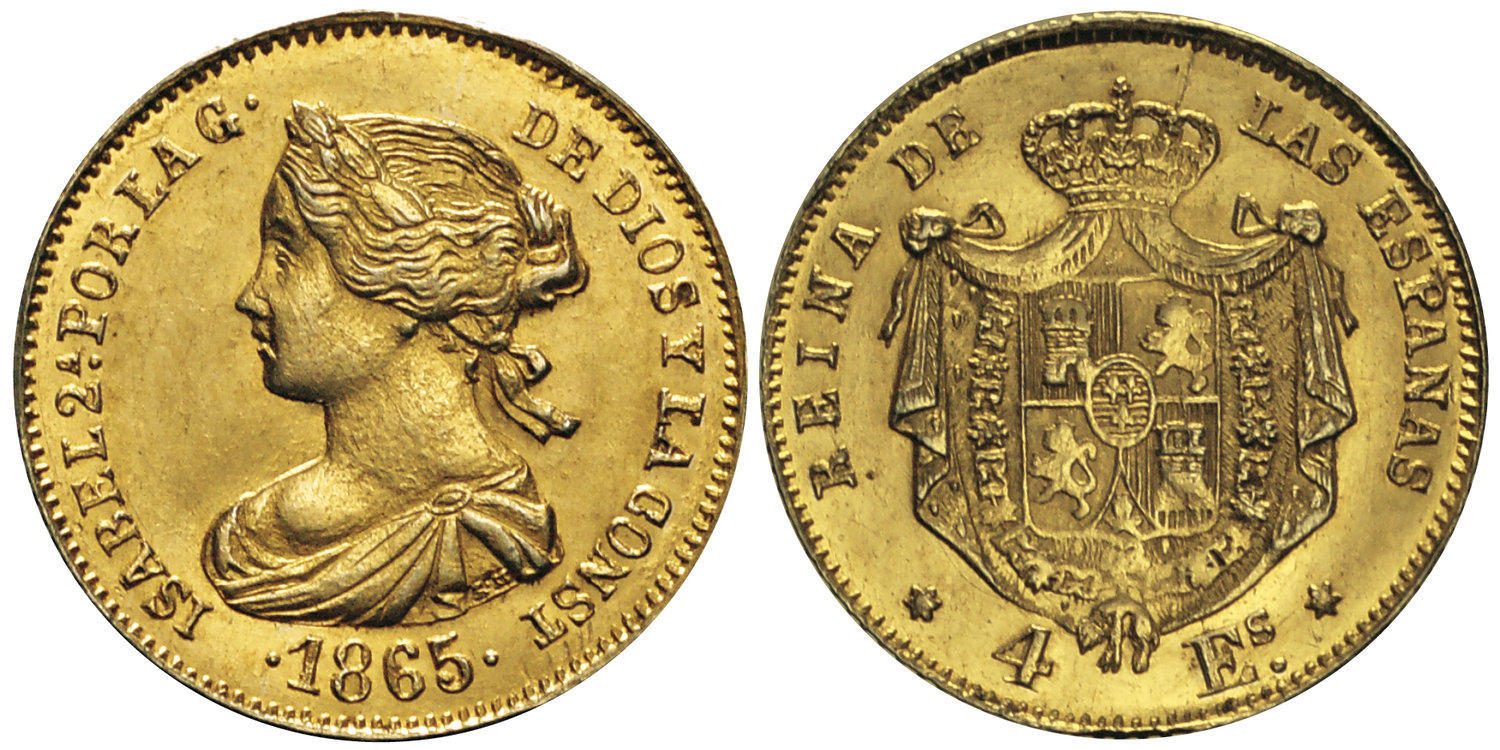
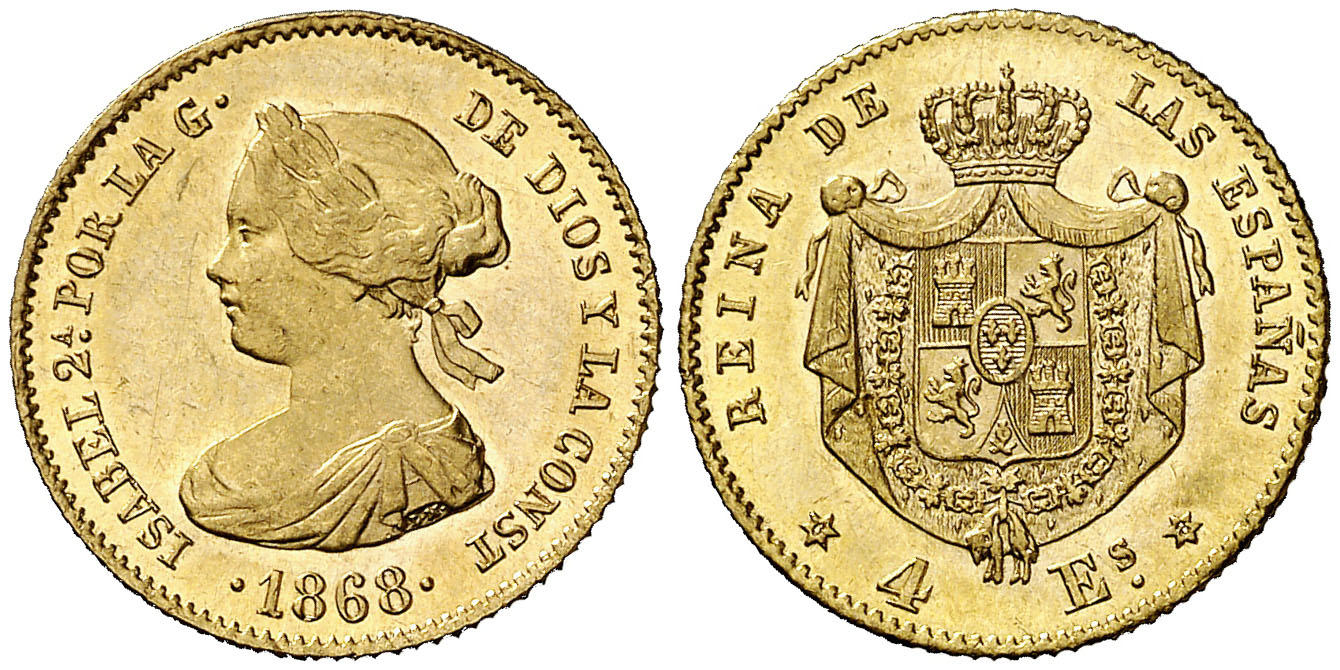
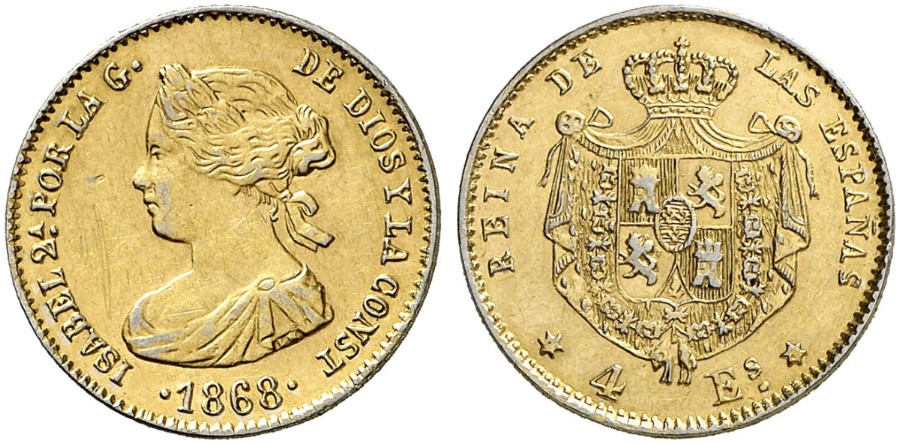
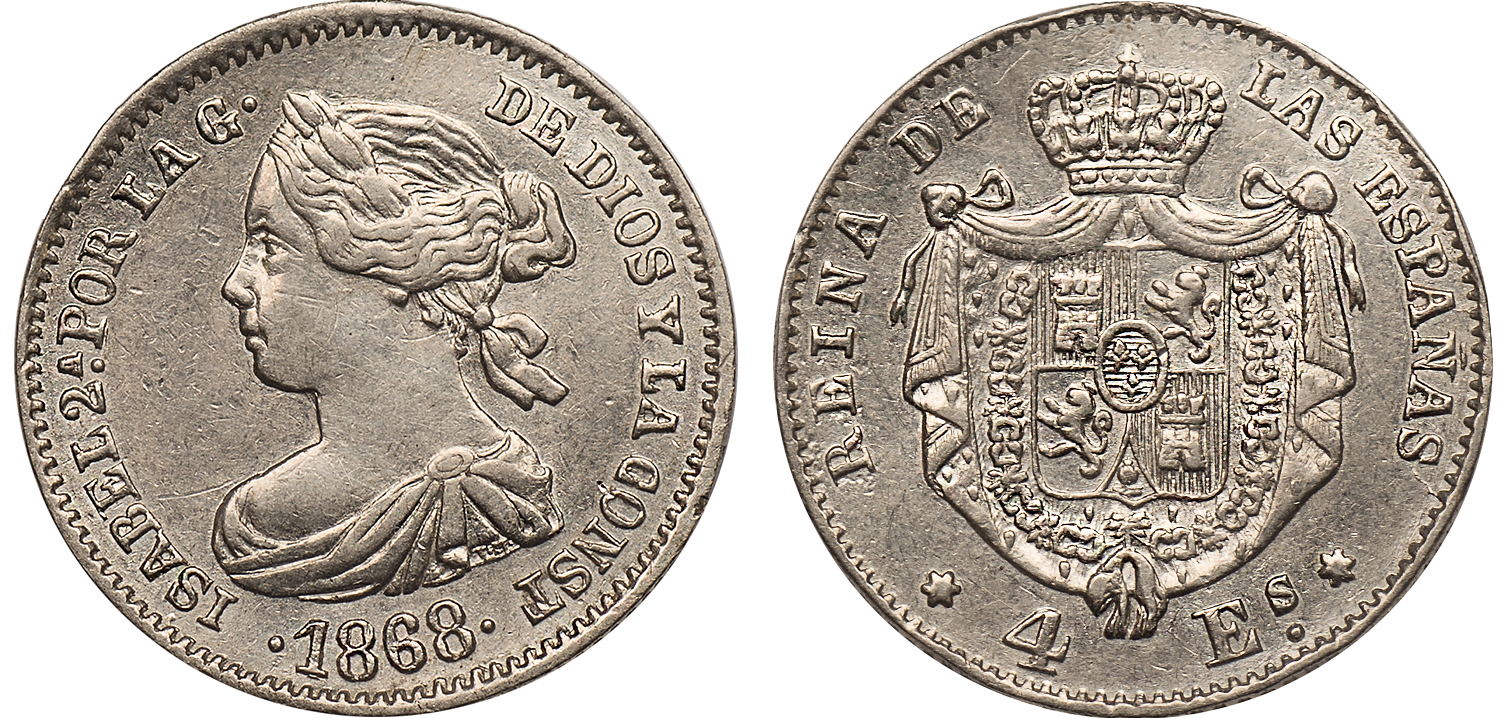
Spain, 1869: Counterfeit Escudos


 Citation: L'Économiste français, Vol.4, Pt. 2 (9/9/1876), p.350


The 4 Escudos Coin should weigh 3.3548 g. (0.10786 Ozt) with 3.0193 g. (0.0971 Ozt) Fine Gold.  In alloy to mimic the .900 standard Gold of Spain, a full-weight Gold-plated Platinum planchet would be 81.5% Pt, 18.5% Cu, or ~ 2.73 g pure Platinum.

4 Escudos Isabel II, 1868: 18 mm; KM#631.1, Fr.337 
3.29 gr, Platinum .815 ; "SUP/FDC" (~MS-63?)


4 Escudos Isabel II, 1868: 18 mm; Calicó 112 ; Fb. 337  
3.36 gr: Gold .900 ; "EBC" (EF-40?)
  
  
4 Escudos Isabel II, 1868: 18 mm; R TTB.; 
3.34 gr, Platinum .815 (2.72 g. Pt)

Price Realized was 250 (+12.10% = 280.25/ USD$ 363.71) on November 23 2012; 
11/23/2012: Platinum Spot was USD$ 1,584, so the numismatic premium was 162.36% over intrinsic.


4 Escudos Isabel II, 1868: 18 mm; Fuchs 60; Schl. 271.1; 
3.29 gr, Platinum .815 (2.68 g. Pt)

Price Realized was 280 (+23% = 344.40/ USD$ 468.71) at Fritz Rudolf Künker GmbH & Co. KG  Auction 251, on July 3, 2014.
7/3/2014: Platinum Spot was USD$ 1,502, so the numismatic premium was 180.89% over intrinsic.
 
http://www.coinarchives.com/6f3f0c0494309ce949eec71ba1be2658/img/kunker/251/image03189.jpg


4 Escudos Isabel II, 1865: 18 mm
3.35 gr Gold .900; "BB+" (VF-30?)


4 Escudos Isabel II, 1868: 18 mm? (cf.KM.631.1; cf.Fr.337)
3.33 gr, Platinum .815 (2.714 g. Pt) "BB+" (VF-30?, not EF)

Price Realized was £ 120. (+24% = £ 148.80/ USD$ 241.68) at St. James's Auctions Ltd, Auction 30 on 9/29/2014. Platinum Spot was USD$ 1,306. so the numismatic premium was 219.17% over intrinsic.


http://www.coinarchives.com/66aa523734fcb3e7b5a9051d09e5d215/img/stjames/030/image00313.jpg


January 14, 2014

France, 1801


1793: 1 Troy Oz. Platinum (Paris First Base Cost) = L.T. 45.53 (S$ 11.83)

Fall 1795 - Fall 1801: 1 Troy Oz. Pt (Mfg Cost, Estimate) = Fr. 15.2361 / 15.238

Fall 1795 - Fall 1801: 1 Troy Oz. Pt (Mfg: Actual Cost) = Fr. 31.102
 
The total weight of the final delivered Platinum product (4 Meters, 4 Kilograms) should have been ~416.603 Ozt (~12.96 Kgs) ; the weight of Kilogram known, the Meter is presumed 72 Ozt. 

Jannetti was actually paid Fr. 12,922.10 for the eight (8) items.

1.The first Meter & Kilogram required 136.846 Ozt Platinum (Assume: for the Metre ~92.25 Ozt, for the Kilogram 44.6 Ozt) (~28.13% wastage on the Meter; ~38.72% wastage on Kg.)
2. Second Meter required 90.08 Ozt (~25.11% wastage on 2nd Meter)
3. The first Meter was reworked, + 8.861 Ozt (~40.43% wastage on 1st Meter
4. Second Kilogram required ~36.92 Ozt (~14.83% wastage)
5. Third Kilogram required ~37.90 Ozt (~17.89% wastage)
6. Third Meter required 85.406 Ozt (~18.62% wastage)
7. A Kilogram was reworked, ~44.303 Ozt (~37.8% wastage)
8. Fourth Meter required 80.85 Ozt (~12.3% wastage)

Citation: Annales de chimie et de physique, 1882


c.1799: by fusing with metallic arsenic, Jeannetty's Platinum was probably ~1% metallic Arsenic, 7.2% Iridium and 91.8% Platinum or 1.10% As, 13.8% Ir and 85.10% Pt


1801: 1 Troy Oz. platina (Estimated: Cartagena Mkt) ~ Fr. 2.37
1801: 1 Troy Oz. platina (Estimated: Jamaica Mkt, 25% higher) ~ Fr. 2.95
 

April 10, 2013

France, 1875

Where the cost of refining was presumably ~Fr. 24./kg, 1 kg Pt = Fr. 1,094. - Fr 1,360
 
1875: 1 Troy Ounce platina (Paris, Retail) = Fr. 24.88
1875: 1 Troy Oz platina (Paris, Ret.) = Fr. 31.10

1875: 1 Troy Oz Pt (Paris: Intrinsic) = Fr. 33.265 - 41.582
1875: 1 Troy Oz Pt (Paris: Small Producer Cost) = Fr. 34.01 - 42.33
1875: 1 Troy Oz Pt (Paris: Small Producer Mfg) = Fr. 35.93 - 44.25


Per Kg: Fr 1,000 > Fr 938.35 > Fr 914.24 > Fr 683.85 > ~ Fr 445. - 513.

1875: 1 Troy Oz Platinum (Paris: Mfg, Bulk) = Fr. 31.10 
1875: 1 Troy Oz Platinum (Paris Net Mfg) = Fr. 29.19
1875: 1 Troy Oz platina (Paris: Intrinsic) = Fr. 28.44
1875: 1 Troy Oz platina (Paris: Ore: break-even) = Fr. 21.27
1875: 1 Troy Oz platina (Paris: Ore, Bulk) ~ Fr. 21.27

Citation: Bulletin de statistique et de législation comparée, Vol. 56 p.645


The Platinum Still which cost Fr 41,000 in 1872 cost Fr 50,000 in 1875: the reported price had risen 21.95% in three years.

Citation: Bulletin de la Société chimique de Paris, Annee 1876: 1er Semestre Tome XXV, p.


1875: 1 Troy Oz Platinum (Paris: Intrinsic, Bulk) = Fr. 31.10 


Citation: Le Moniteur scientifique du Doctor Quesneville: Journal ..., Vol. 39-40 G. A. Quesneville, p.664


1875: 1 Troy Ounce Platino-Iridium (Unique) = Fr. 101.98

1875: 1 Troy Oz. Platinum (Unique) = Fr. 90
1875: 1 Troy Oz. Iridium (Unique) = Fr. 200


Where the assumed intrinsic value of Gold-plated "Platinum" counterfeit FF 20 (0.1866 Ozt Fine Au) was ~Fr. 4. with 5.26 g Fine Platinum (Counterfeit Alloy: 81.5% Pt, 18.5% Cu with a Specific Gravity of 17.3 matches the Napoleon) actual Platinum cost delivered is unknown.


1874/5?: 1 Troy Oz Platinum (Paris: Intrinsic, Scrap?) ~ Fr. 23.66

Citation: Documents Rélatifs À la Question Monétaire Recueillis Et Publiés en Fascicules (1877) 1/20/1876


In this way, on a large scale, and or over 6 years (since before 1870), Isabellines, Napoleons, Sovereigns have manufactured in Spain. A certain quantity of these coins was introduced to  France by both trade borders by Carlist refugees.  Back in 1870, one of us had the opportunity to review a collection of these fake currencies.  A new collection has been exhibited in the conference of 1876, and we've seen that the forgers had made very considerable progress and were clean their latest products to deceive the public. 
[...]
Manufacturing centers are mainly Valencia and Barcelona. The workshops are equipped with hydraulic presses with which were stamped noiselessly "blanks" of platinum. One workshop in Barcelona would have provided for a million and a half of counterfeit currency; another would work in much larger proportions. The workshops were very well equipted and serviced by qualified mechanics and engravers. The sheets are produced in various parts of Europe by industrialists whose address was communicated; these sheets, according to the witness, were all 25 cm long, 8.5 cm wide and 0.3 cm thick. 

Alloy: 95% Pt, 5% Cu

Citation: Accounts and Papers of the House of Commons;  Great Britain. Parliament. House of Commons (1877) p.31


BELGIUM:

1875: 1 Troy Oz. Platinum (London: Intrinsic) = Fr 32.66

In reply, (to Ignatz Sroof, Direcrtor of the Griesheim Works near Hoechst/Frankfurt, Bavaria) Gustav Delplace of Namur Belgium cited Belgian prices for Platinum acquired from Johnson Matthey:

In the past 5 years, the price for 1 kg refined platinum fluctuated between Fr. 1,050 and Fr. 1,200  depending on the market price for the ore. {...} For the past 5 years, my apparatuses are from the platinum manufacturers Johnson Matthey & Company (Hatton Garden) made ​​in London.

Citation: Chemie-Arbeit in Werk und Labor, Vol. 3 1/1880 p.11


c.1875 Lightning Rod Tip often Lead, not pure Platinum

In Platinum, Chapuis Lightning Rod Tip weighed 10.627 Grams (~0.342 Ozt)