1825: 1 Troy Ounce platina (SPb: Ore 80%) = 7.1625 руб Acc.
The first buyer was the government. From the years 1825-1843 the delivery of the whole platinum gained to the Crown was required. The price paid was initially (1822?) 60 Kopecks per Zolotnik, or {140.66 руб Acc.} per kilogram, with 10 to 12% deducted by the assayer {123.78 руб Acc., net}. Three years (1825?) later, it rose to {230.31 руб Acc.} per kilogram and finally the coining period (1828-1843) to {290.25 руб Acc.}
Citation: Prometheus: Illustrierte Wochenschrift über die Fortschritte..., Vol. 18, No. 904, p.309

Citation: Annales des voyages, de la géographie, de l'histoire et de l'archéologie 2nd Series, Vol 2, (Nov. 1826) p.116

Estimating 330.36 Pouds (173,982.6 Ozt) platina at 3,805,520 руб Acc.
1824-30: 1 Troy Ounce platina (SPb: Ore 80%) = 21.873 руб Acc.
1824-30: 1 Troy Oz. Platinum Sponge (SPb: Ore 80%) = 21.873 руб Acc.
1824 Russian platina yield (1.825 Pouds): 29.9 Kgs = 961 Ozt.
1825 Russian platina yield (11.6 Pouds): 190 Kgs = 6,109 Ozt.
Citation: Narrative of a Visit to the Courts of Russia and Sweden: In the Year 1830 & 1831, Vol. 2; Charles Colville Frankland (1832)


Erroneous estimation.
1824/5 Russian platina yield (16.29 Pouds): 16.29 Kgs = 523.74 Ozt.
1826 Russian platina yield (27.681 Pouds): 453.4 Kgs = 14,578 Ozt.
1827 Russian platina yield (25.767 Pouds): 422.1 Kgs = 13,570 Ozt.
1827 Russian platina yield (54.44 Pouds): 891.793518 Kgs = 13,570 Ozt.

From Russian sources, Iridosmine was discovered (1824) and identified by 1825. Laugier estimated the Russian platinum ingot to be 80% pure Pt, 14.44% platina-black and ~6% other metals/slag.
The best quality ore was 86.5 - 88% Platinum, the standard ~73.6 - 78.9% and the lower quality ~70% by 1834.

In June 1825, Russian-manufactured bar-platina was initially described 65% Pt, 20% Ir and 15% Other (9% Ir, 4% Os, 2% Other?)
Citation: Annales des sciences naturelles, Vol. 5 ; Jean Victor Audouin, Jean-Baptiste Dumas p.334

1834:

1828 analysis:

October 18, 1825: major platina mine discovery of March 1825 (Perm) reported in St. Petersburg. Reported in Central Germany (via SPb) three weeks later.

1912 Summary of early Russian period, uncertain forex.
IF "pound" = фунт (410 Grammes) and IF USD$ 3. (=

Winter 1825: Platina price in SPb "falls by one-third."
Citation: Augsburger Allgemeine Zeitung, # 315, 11 Nov. 1825 (1825) p.1260

Mid-1826: The major discovery and how news effected the platina market in the Winter of 1825/6 reported in Western Europe (2-3 month delay.)
Citation: Nouvelles annales des voyages, de la géographie et de l'histoire, Vol. 32; Jean Baptiste Benoît Eyriès, Malte-Brun, et al. (1826) p.119

1824-6: 1 Troy Ounce of Platinum = "very dear & scarce"
c.1821: Platina was too expensive to be considered useful for counterfeiting Gold coin
Citation: Chemical instructor: presenting a familiar method of teaching the chemical ...; Amos Eaton (1822)

By 1825, platina ore of commerce was commonly assumed by Americans, from English scientists (William Phillips?) to have Specific Gravity 15.6.
Citation: Manual of Mineralogy and Geology: Designed for the Use of Schools... Ebenezer Emmons (1826)

 c.1812 (1818):

c.1814 (1815):

1824-6:Reportedly, Anthony Plantou introduced porcelain teeth to America. He arrived in the USA from Paris in 1817 and began the manufacture circa 1820.

In 1822, Charles W. Peale was not the first to employ Platinum pins, but he was likely the first American to do so. (He was not a dentist.)


It follows that Plantou's 'scarcity of platina' refers to experiments carried out in 1824-6 for this patent application made in 1826 or 1827 and granted on April 5, 1828.
Citation: Journal of the Franklin Institute, Vol. 3, No. 5, p.44
Platinum pins employed in Parisian dentistry, c.1808:

Gold premium, 1825:

The Death of Emperor Alexander (30 November 1825) was reported in New Orleans 10 weeks later; 'news from London' arrived 7 weeks later.

The 1826 Coronation of Nicholas I, issued in varying weights. {Up to 15.6 g / 3.657 Zolotnik though often 6-12 grams} Sev-399A; Diakov-446.9
See Heritage Auctions World Coin (CICF) Auction Catalog #3009, Rosemont, Ill: 12.4 g.
The Platinum coronation medal weighed 13.56 g. (3.1788 Zolotnik)
The Silver coronation medal of the same dimension weighed 4.25 g.
Citation: Narrative of a Visit to the Courts of Russia and Sweden: In the Year 1830 & 1831, Vol. 2; Charles Colville Frankland (1832)


Mid-April 1826: News of the Second-Half 1825 Annual Gold Yield reached Germany ; no mention of any platina discovery, however.
Citation: Oesterreichischer Beobachter p.521

As reported in Paris in late July 1826, in the Winter of 1825 the St. Petersburg price had declined by 1/3rd. The second semester 1825 yield would have arrived in April or May 1826; expedient commercial news to Paris arrived 5 weeks later, early-mid June.
"These mines are so rich, this ensures that they have reduced Platinum {price} by one-third in St. Petersburg. "
Citation: Le Globe, 7/20/1826 ; Vol. 3 p.729
 July 1826: The price had fallen 1/3rd between the Winters of 1824 and 1825.
 January-March 1827 Volume;
 Citation: The Encyclopaedia Britannica: Or, Dictionary of Arts..., Vol. 7; Vol. 15 (1842) p.254


Where the 1824 daily wage was 48 Silver Kopecks (=


“A History of Platinum and its Allied Metals”, by Donald McDonald and Leslie B. Hunt
George Matthey records in a letter dated Junee 9th, 1851, of which the copy is still preserved by Johnson Matthey , that: “Mr Johnson twenty-four years ago supplied the Russian Government at the request of Chevalier Benkhausen (the Russian Consul in London) with every information respecting the method of preparing platina, the intrinsic value, uses, andadaptation to coinage as a currency or circulating medium. ”
Coincident with the high production of valuable Platinum, 1826 & 1827 were two of the more stable years of the St. Petersbourg money-market.
The Great Coronation Medal of of Nicholas I weighed ~15.6 g (~3.646 Zolotnik)
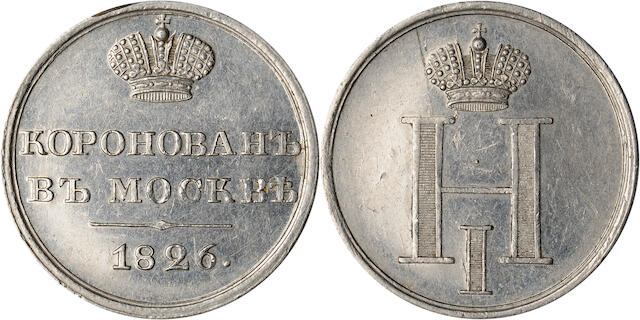 A slightly worn example sold at Bonhams' in NYC for
US$ 12,870 (including premium); the Spot Price was $1,673. Presuming the medallion .970 Fine Pt and a retail bullion premium of 5%, the numismatic premium on 12/8/2010 was 1,317%.
In 1862, for a similar medal, the German numismatic premium was ~2,957% the bulk price of manufactured Platinum.
A slightly worn example sold at Bonhams' in NYC for
US$ 12,870 (including premium); the Spot Price was $1,673. Presuming the medallion .970 Fine Pt and a retail bullion premium of 5%, the numismatic premium on 12/8/2010 was 1,317%.
In 1862, for a similar medal, the German numismatic premium was ~2,957% the bulk price of manufactured Platinum.


