October 16, 2011

Adam Smith's Inquiry into the Wealth of Nations (Editor's Note)

A Note (XLI) by Marquis Garnier in the Second French Edition (after 1802) correctly translates von Humboldt's 1801 Colombian price "Fr 40 per libra" (castellano) as Fr 80 per kilogramme. The kilogramme was based on the poid of 2 marc (the marc divided into 8 ounces); the Castellano was analoguous to the marc.

By direct implication and logic, von Humboldt's cited Paris platina price was for the approximate 500 gram 'poids de marc' and not per kilogram. Otherwise, the estimation would nonsensically, double the weight, or halve the price of all precious metals.
Footnotes in the Second Edition manuscript date to 1821, when von Humboldt was still resident in Paris.  From 1815-20, the Paris price for the best platina (Fr 4.06 -5.08) was  approximately and consistently ~4x more expensive than the Colombian source ; cheap grades of ore were likely sold at lower rates.  It's interesting to note that Paris platina had often been only ~3x more expensive than the source earlier on (1800 - 1810) but rising global demand for Platinum intensified European speculation in the raw commodity around 1820 (more explicitly than Garnier revealed.)

Vulgar speculation in refined Platinum, in Paris & London, likely appeared two years later, in 1822/3, as rumors of the Colombian government's interest in coinage circulated.

c.1821
The amount of platinum that comes annually to the European market is perhaps not a thousandth of the amount of money coming into the same market, yet a mark of platinum is not worth the two cinqu1èmes of a mark of money. According to Humboldt, platinum is worth only 80 francs per kilogram instead of the extraction, although the trade sell-often three to four times more expensive, because in an article also scarce, dealers are almost always the key to the law to those who seek to fill it.

Citation: Recherches sur la nature et les causes de la richesse des nations; Adam Smith Vol. 5 (1822) p.663


From von Humboldt's original (ms. of 1809):

October 15, 2011

UK, 1816

Wm. Cary sold Dr. Young 32.225 ozt Platinum  for £ 28.20. Cary was retailing Wollaston's (Manufactured?) Platinum for 17.5s/Ozt.
 
1816: 1 Troy Ounce Platinum (Cary: Semi-Mfg, Bulk)  = £ 0.8751 (Fr 21.70)
1816: 1 Troy Oz. Platinum (Ask?: Scrap, Fletcher)  = £ 0.5641 (Fr 14., S$ 3.90)

1820?: 1 Troy Oz. Platinum (Ask?: Scrap, Johnson)  = £ 0.6441 (S$ 4.45)
 
Wollaston's bulk platina purchases are both consistent with these price variations and ~75% - 80% of the wholesale price quoted to chemists.

Wollaston sold ~3,100 Ozt (~96.4 kgs) Platinum in 1816.

Usselman (1978: PMR Vol. 22, No.3) noted that Wollaston's orders typically took 200 days (or nearly 7 months) to deliver, sometimes much longer.   This suggests at least 3.5 months trans-Atlantic delay of news to/from Cartagena (if London<>Kingston was 4 months' round trip) and five months to Choco.  
 
Between the Spanish source and the London market, the forex variation between the Spanish piastre and Pound Sterling (Paper currency) explains how merchant banks came to dominate this trade.  Beyond mere commodity, platina may also have had a role as collateral in Jamaican merchant debt and against all forms of paper (monetary substitute.)

1815: 1 Troy Oz. Platinum (retail)  = £ 1.25 - 1.75 (USD$ 5.89 - 8.25)

Bollman's Presentation to Great Britain:


Dec. 1816:  

London: $S 1. (Paper) = £0.1458 ; $S 6.857 = £ 1.
Jamaica: $S 1. (Spanish Coin & English Paper) = £0.33 ; $S 3. = £ 1.
London: $S 1. (English & Spanish Coin) = £0.2156; $S 4.6377 = £ 1.

Citation: A complete system of theoretical and mercantile arithmetic; George G. Carey (1817) p.357


c.1816

October 14, 2011

France, 1817

Assuming the Kilogram 32.68387 Paris Onces
Pd.M. Rate is Fr.64.- 80. ; Kg Rate is Fr. 130.-165.


c.1817: 1 Troy Oz. platina (Common Ore, Paris Spot) = Fr 5. (£ )

Citation: Nouveau dictionnaire d'histoire naturelle..., Vol. 26 (1818) p.583


Possibly Late 1816 news, reported by C.L. Cadet.
 

c. February, 1817:
Citation: Journal de pharmacie et des sciences accessoires, No.3, March 1817 p.242


c. March, 1817: 
March, 1817: 1 Troy Ounce Platinum (refined) = Fr 13.76 (£ 0.554)
March, 1817: 1 Troy Oz. Platinum (semi-mfg) = Fr 14.74 (£ 0.593) 
March, 1817: 1 Troy Oz. Platinum (assembly) ~ Fr 2.54 (£ 0.102)
March, 1817: 1 Troy Oz. Platinum (fully mfg still) = Fr 18.29 (£ 0.7360)

1817: 20 Kilograms Platinum Ingot > 15.5 Kilogram Platinum Still of 162 Litres

Citation: Bulletin de la Societe D'Encourgement Pour L'Industrie Nationale (1817) p.68


March 1817: reporting, with errors!


April, 1817: 1 Troy Oz. Platinum (Refined) = Fr 13.76 (£ 0.5651)
April, 1817: 1 Troy Oz. Platinum (Semi-Mfg) = Fr 14.74 (£ 0.6053)
April, 1817: 1 Troy Oz. Platinum (Assembly) ~ Fr 2.54 (£ 0.102)
April, 1817: 1 Troy Oz. Platinum (Fully Mfg Still) = Fr 17.28 (£ 0.7097)


(Apparently written with great detail & expansive knowledge, after 1815 and the Mint's acquisition of the famous 1816 Jeanetty boiler.)

Platina grains were sold by the lot, sorted and sight-graded by size and apparent purity; no reference to specific gravity.  This Paris Price was 33% - 54% higher than Wollaston's cost, suggesting a trade rate.

c.1818?: 1 Troy Ounce platina (Paris, trade) = Fr 4.06 - 5.08 (USD$ 0.93)

Citation: Nouveau dictionnaire d'histoire naturelle, appliquée aux arts..., Vol. 26; Charles S. Sonnini (1818)


The key was to simplify the processing and it is this simplification, it is above all the company made ​​more than had great yet been done, which determined a reduction by half in the price of platinum, for the ore has increased rather. 

One can hardly boast of a further decline before a very great abundance of ore and considerable demands require to deal with at once larger quantities, and your Committee believes that the price of Fr. 15 - 18. an ounce, which is now reduced, making it accessible to many manufacturers. In this respect, MM. Cuoq and Couturier have done a great service to the arts, they would make even more if they could lower their prices.

You, gentlemen, on many occasions, encouraged Mr. Jannety, you constantly applauded his success, and you are always willing to assist his efforts and perseverance in working platinum.


July 16, 1817: Albert Gallatin recommends a Platinum metre manufactured by Fortin for the cost of £ 105.  The Platinum metre received was 125 cm3 (5 mm * 25 mm * 1,000 mm)
at a presumed density of 20.5487 (c.1873: noting the arsenical alloy) a total weight of ~ 2.57 Kgs or 82.58 Ozt. for the French Unit.

July, 1817: 1 Troy Oz. Platinum (Paris: Mfg) ~ £ 1.2715 (Fr. 30.963) 


March, 1818: 1 Troy Oz. Platinum-Clad Copper (Semi-Mfg) = Fr 2.86 


1817: Bréant of Paris produced a Platinum still of 162-litres weighing 15.5 kg for Cuoq & Couturier's 1816/7, the weight per Litre was 3.076 Troy Ounces; the amount of Litres contained per Troy Ounce was 0.3251 Litres.


October 13, 2011

France, 1818


By early 1819, Dr. Wollaston heard about Paris-made Platinum retorts but appears confused about the capacity, not weight or the price. 

A 900 Ozt Still was 28 Kgs. At that point in time, perhaps for 20 years after, there is no record of a Platinum Still that size in Paris or London.

A "30 Gallon" still was 144.5 Litres (old Gallons) or 136.4 Litres (30 Imperial Gallons) and by contemporary Paris manufacture should have weighed ~ 13 - 14 Kgs (420 - 445 Ozt.)

March 1817: Cuoq's 15.5 Kg Platinum Still of 162 Litres/~43 gallons, presumably offered for "Fr. 18./Once."

1819: ~"20 Kg." Platinum Still of 200 Litres/~53 gallons, presumably offered for

1818: 15s. ~ Fr. 18.30 = Fr. 18./Once.

1818: 1 Troy Oz. Platinum (Paris: Bréant's Mfg, Bulk) = Fr 18.30 (USD$ 3.40)
 
See Usselman, PMR 1978, 22; 3 pp.100-106
Feb., 1819. I understand from Mr. Tennant that [platinum] retorts have been made in Paris
of about 30 gallon capacity and weighing about 900 ounces at 15 shillings per ounce (8).
 
1817?: 1 Ozt. Platinum (Paris: Bréant? Semi-Mfg?) = Fr 18.30

Citation: Handbuch der populären Chemie; Ferdinand Wurzer (1818) p.112

1818: 1 Ozt. Platinum (Paris: Jannetty, Semi-Mfg?) = Fr 18.30 (USD$ 3.40)

Citation: Johann C. Leuchs, Allgemeines Waaren-Lexicon; oder vollständige Waarenkunde: ..., Vol. 2 (1826) p.113


Perhaps dated reference.

Citation: Kunst- und Gewerbeblatt des Polytechnischen Vereins ..., Vol. 5 ;Polytechnischer Verein für das Königreich Bayern (May 1819)


1817: 1 Ozt. Platinum (Paris: Bréant's Semi-Mfg, Bulk) = Fr 15.25
1819?: 1 Ozt. Platinum (Paris: Bréant's Mfg, Bulk) = Fr 18.30

Citation: Dictionnaire de l'artillerie; H. Cotty (1822) p.337

Then Colonel (Gaspard-Hermann) Cotty (1822), later Baron General

1818: Suspect republication (c. 1812?) or Retail rate

Specifically referencing "chemical apparatus and skilled artisan products" :

Now an Once of worked Platinum costs only Fr. 24 and in London, it costs for worse, less.

1818?: 1 Ozt. Platinum (Paris: Jeanetty's Mfg, Retail) = Fr 24.40 (USD$ 4.54)

Citation: Handwörterbuch der allgemeinen Chemie: M - R Johann Friedrich John (1818) p.228
 

Where the Poid de Marc (16 Onces) =15.7378 - 15.7425 English Troy Ounces (15.74 Ozt)
and the Spanish Libra 2 Marc = 14.8208 English Troy Ounces

1 P.d.M. (@ Fr 4./Once) = Fr 64. ; (@ Fr 5./Once) = Fr. 80.
1 Livre P.d.M. (@ Fr 4./Once) = Fr 128. ; (@ Fr 5./Once) = Fr. 160.

1 Spanish Libra, @ Fr 4./Once = Fr 60.20, @ Fr 5./Once = Fr. 75.25
1 Pound Avoirdupois, @ Fr 4./Once = Fr 59.31, @ Fr 5./Once = Fr. 74.13
1 Kilogram @ Fr 4./Once = Fr 130.75, @ Fr 5./Once = Fr 163.43

In S$ @ Fr 4./Once, 1 Libra = S$ 12., 1 Troy Pound = S$11.86, 1 kg = S$ 26.15
In S$ @ Fr 5./Once, 1 Libra = S$ 15., 1 Troy Pound = S$14.83, 1 kg = S$ 32.69 

c.1814/7?: 1 Ozt. platina (Paris: whols.?) = Fr 4.06 - 5.08 (USD$ 0.76 -0.93)

1817: 1 Ozt. platina (USA: Vaughan of Phila.) = Fr 2.21 ($ 0.4114; £ 0.1082)


Citation: Nouveau dictionnaire d'histoire naturelle, appliquée aux arts..., Vol. 26;  Jacques Eustache de Sève (1818) p.583


Citation: Minéralogie appliquée aux arts: ou, Histoire des minéraux qui sont ..., Vol. 1 ; Cyprien Prosper Brard (1821) p.633


1819:
Although Wollaston could not obtain platinum, his competitors in the platinum vessel business, the French, had ample supplies, for about 1819, Jean Bréant, assayer of the Paris mint, was given permission by the Spanish Government to process the nearly 30,000 ounces of crude platinum held by Spain since late in the eighteenth century (7).

In Germany, the platina price had started rising by late 1818; Paris Platinum had likewise advanced ~25% from the low (c.1814-1816.)

By 1815-19, there was some (limited?) Platinum refining in both Berlin and Wien.


1816: 1 Ozt. Platinum (refined) = Fr 14.22 (USD$ 3.07)
1817: 1 Ozt. Platinum (refined) ~ Fr 15.24 (USD$ 2.84)

1818: 1 Troy Ounce Platinum (Paris: Mfg) = Fr 18.29 (USD$ 3.42)

March, 1819:
"However, since the current stock of the metal has been reduced by ever increasing use, so the price of the crude metal starts to rise."

1818/9:
Citation: Bayerisches Industrie- und Gewerbeblatt; Polytechnischer Verein in München (1819) p.264


c.1818, possibly dated (refined) Platinum Price

Citation: Handbuch der populären Chemie: zum gebrauch bei vorlesungen... ; Ferdinand Wurzer (1820) p.112

A discussion of Platinum presented at the 1819 Exposition, where ore price seems dated and exceeding low.

Recognition for Bréant's extraordinarily efficient Platinum Still (March, 1818):


1818/24?: vague price, intermediate to Au/Ag
"Whether it is rarely the same as the yellow gold, it is still a little lower in price, but it is dearer than silver."

Possibly dated materials (circa 1818)!

In a Supplement, presumably au courant: these are low prices (wholesale.) Here, the Platinum Price is nearly double that of Silver: almost certainly a LOW for the refined metal.

In 1831, France imported about 3,215 Troy Ounces and exported about 1,900 Troy Ounces, equivalent to about three (3) sulphuric acid boilers. 

Of Platinum basins, total estimated weight 3 Ozt
"2 Onces" = 60 cc. (Est. 2.11 Imperial Ounces) is ~1.1 Ozt/ 34.2 g. Platinumware
"4 Onces" = 120 cc. (Est. 4.22 Imperial Ounces) is ~1.9 Ozt or 59.29 g. Platinumware


c.1831?: 1 Ozt Platinum (Manufactured) = Fr 36 (USD$ )

c.1831: 1 Ozt. Platinum (manufactured) = Fr 17.72 (USD$ 3.39)
c.1831: 1 Ozt. Platinum (refined, unmfg) = Fr 18.32 (USD$ 3.50)
c.1831: 1 Ozt. Silver (refined, unmfg) = Fr 7.26 (USD$ 1.41)

c.1831: 1 Ozt. Platinum (refined) = Fr 15.- 18. (USD$ 2.88 - 3.45)


Citation: Supplément au dictionnaire de l'artillerie, Hermann Cotty (1832), p.335-6


Citation: Manuel de l'armurier, du fourbisseur et de l'arquebusier: ou Traité complet ... A. Paulin-Désormeaux (1832) p.200

 
c.1817/8?: Labor/PM Materials in French Jewelry Production


October 11, 2011

USA, 1823: Platinum Points

Platina Lightning Rod Points manufactured by machinist (clock- and gun-manufacturer) & mineralogist Isaiah Lukens (1779-1846) of Philadelphia.

These lightning-rod points  probably sold for $5. each.

1823:

October 6, 2011

USA, 1814

Where 1 Lb. avd. = 14.583 Ozt., the intrinsic price of Pt was ~$ 8.57/Lb. avd.

1814: 1 Troy Oz. platina (whols., Ore 70%) = USD$ 0.613

1814: 1 Troy Ounce platina (US port: bulk, whols., $6./lb. avd.) = USD$ 0.4114
1814: 1 Troy Oz. Pt (intrinsic @ 70%) = $0.58775

 1814: 1 Troy Oz. Platinum (Assumed labor, $6.425./lb avd) ~ $0.44057

1813: 1 Troy Oz. Platinum (Producer Boiler Price) = $ 4.286
1813: 1 Troy Oz. Platinum (Producer Boiler Cost) = $ 2.857
1813: 1 Troy Oz. Platinum (Producer Boiler Profit) = $ 1.429

1814: 1 Platinum Lightning Rod Tip (Producer Whols.) = $ 1.67/ea.

1814: 1 Troy Oz. Platinum (Producer Cost, $15./lb. avd.) = $1.0286
1814: 1 Troy Oz. Platinum (Manufacturer's Price, $60./lb avd) =  $4.115
1814: 1 Troy Oz. Platinum (Mfg's Assumed Profit, $45./lb avd) =  $3.0864

At quoted rates, Bollman's Lightning Rod Tips had ~ 12.64 g or 0.40 Troy Ounces of Pt.


1. April, 1814.
Das Marine-Ministerium hat 300 ($ 500 werth) von meinen Platinaspitzen genommen... Ich habe einen Austrag zu $60. per Pfund angenommen. ... Ich bekomme $60 für das, was mich $15 kostet.

The Naval Department has purchased 300 ($ 500 worth) of my Platinum-Lightning Rods)...I have an accepted assignment for $ 60. per pound.  ... I get $60 for what cost me $15.

27. April 1814.
Du unterschäzeft die folgen meines Thuns. So unterschäten auch wir Beide eindt bie Quercitronrinde, mit welchem Artikel zwei häuser solide Vermögen erworben haben. Wenn ich einen Lieserungsvertrag zu 40 Pfund abschlieste, so kann ich bequem davon leben. Das ist der ungefähre Verbrauch hier zu Lande, Un Lack werben ungefähr 200 Pfund konsumiert; auch diese kann ich zu demselben günstigen Preise herstellen. Meine Platina-Berkaufe beliefen sich im lechten Jahre auf $ 3000 und seit dem 1. Januar c. auf $1300. Dieser Artikel bietet gleichfalls Ausficht auf einen reichen Gewinn. Das Schlimmste ist, das meine Fabrik viel kostet, 

Unterschäzeft you follow my tuna. Both estimates Undercoats thus we offer eindt Quercitronrinde have purchased two homes with solid assets which article. I get $ 60 for what costs me $ 15.  If I am a lockable Liese approximate contract to 40 pounds, so I can comfortably live on.  This is the approximate consumption in this country, Un paint advertise about 200 pounds consumed, even this I can connect at the same affordable prices. My Platinum-Work amounted to $ 3,000 and lighting in years since the first C. January to $ 1300 This article is also fishes out of a rich profit. The worst thing is that my factory costs a lot, consumption here is about to land, Un paint advertise consumed 200 pounds; I can connect to these same low prices. My Patinum-Work amounted to $ 3,000 and lighting in years since the first C. January to $ 1300 This article is also fishes out of a rich profit. The Schlimmfte ift, which costs a lot of my factory,  I'm gebunben from all sides, I work off arrears mechanism, and the cost of learning, the construction costs and the construction of the apparatus be more than $ 2000."

Chaldecott (PMR 1981, No. 4 pp.162-73) cites an 1814 letter* from Erich Bollman to then Secretary of State James Madison. 

Elsewhere mentioned, the c. 1813 price of platina was $5./pound avd in Jamaica and $6./pound avd. in Philadelphia.  From Chaldecott (PMR 1983, Vol. 27, No. 2, p.81):

"[In August 1814, Bollman] told Wollaston that supplies of crude platinum could be obtained from the merchant firm Adams, Robertson & Co. of Kingston, Jamaica, and that smuggled ore could not be bought at Cartagena for less than five Spanish dollars a pound (avoirdupois?) equivalent to 1s. 6d. an ounce troy, and that the price at Philadelphia was six dollars (6)."


Dr. Erick Bollman's Platinum-work was a short-lived venture, but marked the first native Platinum production on record in the USA.  In letters to his brother, Bollman indicates prices (avoirdupoids) for platina & Platinum.  The major project appears to be the 25-gallon sulphuric acid still, ~700 Troy Ounces @ USD$ 3,000. for John Harrison.

If refined 700 ozt (at 70% ore purity) is assumed correctly, the Harrison project required almost exactly 29 kilograms (64 lbs avd.) of raw platina. That large bulk price actually seems high for the period, given the world market (platina glut) but there's no US data to assume the Philadelphia price was ever lower.  

The Boiler cost Bolllman more than $2,000 to manufacture ($384. in platina), with $1,616 in various expenses (laborers, etc.), resulting in <$1,000. profit.

Unfortunately, Bollman underestimated costs and didn't understand the Platinum market.  But he remained a Platinum bug until the end, dying in Jamaica on return from an investigatory expedition on behalf of Barings Brothers to the the 'only source' known; Choco, Nuevo Grenada.


On the US Eastern Seaboard, platina was about half- to one-third the London price.

1814: 1 Troy Oz. Platinum (intrinsic, refined, bulk) = $3.00

1814: 1 Troy Oz. platina (Jamaica: bulk, whols., ore) = $0.338
1814: 1 Troy Oz. platina (US port: bulk, whols., ore) = $0.4114

1814-6: 1 Troy Ounce platina (London: whols., ore) = $0.64 - 0.98

*US. National Archives Building, General Records of the Department of State, Record Group 59, Microcopy M-179, roll 29: letter from E. Bollmann to the Secretary of State dated 16 March I 814. For text of letter see F. Redlich,“Eric Bollmann and Studies in Banking”, New York 1944 pp.84-85

1814: Bollman's entreaty to sell his Platinum to the Commonwealth of Pennsylvania.


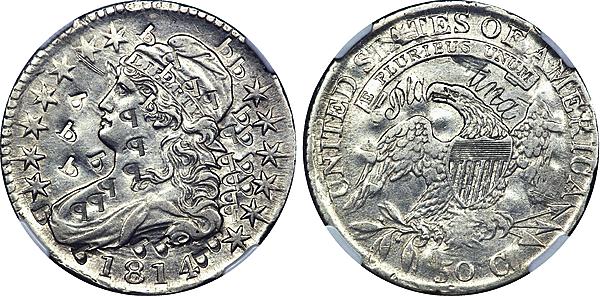
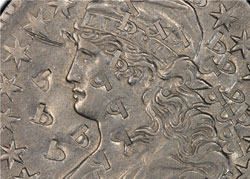
The US Mint held on one of Bollman's Coin Pattern in the early part of the 20th C.  The Platinum was likely accumulated residuum from the Philadelphia Mint's Gold refining operations, after treating ore from Chocó.   

At no additional cost (but for loss paid on 'Gold' ore) the Mint did not knowingly nor intentionally purchase additional platina ore: Pt cost was therefore essentially nil.


The intrinsic value of 0.7181 Troy Ounce Fine Pt @ "USD$ 3./oz" in 1813/4, the intrinsic value this coin would be $2.1544. By the Specific Gravity, however, the Coin appears to be 5% Ag, therefore worth ($2.05 + $0.05) $2.10 at presumed market prices for PMs.

Weight: 344.7 Grains Troy
Specific gravity: 20.9 (95% Pt, 5% Ag)
Diameter: 32.6 mm.

This coin was acquired by Charles Link in August 2011 and certified in 2012:

http://3.bp.blogspot.com/-m3WkPJuEgds/TlJS2rTNLcI/AAAAAAAABfo/kN3Tb114e1c/s1600/1814USp09CABwJ-44NXXXXHE001c.jpg


http://www.pcgs.com/News/PCGS-Certifies-1814-Platinum-Half-Dollar
http://rob.com/russ/collection/2316.html


1758: Reportedly, the Platinum-tipped Lightning Rod was Benjamin Franklin's invention.


Description of a Platina Point:


1814: Accum's Chemistry and Bollman's Platinum in the textbook.

Citation: System of Theoretical and Practical Chemistry; Friedrich Christian Accum, Thomas Cooper (1814)